
Showing posts with label (Level 3). Show all posts
Showing posts with label (Level 3). Show all posts
Tuesday, 6 December 2016





Thursday, 28 January 2016
ChronoZoom is aimed at visualizing the history of everything

ChronoZoom is an open source community project owned by the Outercurve Foundation and dedicated to visualizing the history of everything. ChronoZoom bridges the gap between the humanities and sciences using a notion of “Big History” to easily understand all this information. This project has been funded and supported by Microsoft Research Connections in collaboration with University California at Berkeley, Moscow State University and University of Washington Information School (iSchool), and The Center for Web and Data Science (WDS) departments.

You can browse through all of history on ChronoZoom to find data in the form of articles, images, video, sound, and other multimedia. ChronoZoom links together a wealth of information that has been curated by experts and enthusiasts to tell important stories from history. By drawing upon the latest discoveries from many different disciplines, you can visualize the temporal relationships between events, trends, and themes. Some of the disciplines that contribute information to ChronoZoom include biology, astronomy, geology, climatology, prehistory, archeology, anthropology, economics, cosmology, natural history, and population and environmental studies.
Thursday, 15 November 2012
The Cognitive Benefits of Being Bilingual
Today, more of the world’s population is bilingual or multilingual than monolingual. In addition to facilitating cross-cultural communication, this trend also positively affects cognitive abilities. Researchers have shown that the bilingual brain can have better attention and task-switching capacities than the monolingual brain, thanks to its developed ability to inhibit one language while using another. In addition, bilingualism has positive effects at both ends of the age spectrum: Bilingual children as young as seven months can better adjust to environmental changes, while bilingual seniors can experience less cognitive decline.
Tuesday, 1 February 2011
Google Art Project


Explore museums from around the world, discover and view hundreds of artworks at incredible zoom levels, and even create and share your own collection of masterpieces (Go).
- What is the ‘Art Project’?
- A unique collaboration with some of the world’s most acclaimed art museums to enable people to discover and view more than a thousand artworks online in extraordinary detail.
- Explore museums with Street View technology: virtually move around the museum’s galleries, selecting works of art that interest you, navigate though interactive floor plans and learn more about the museum and you explore.
- Artwork View: discover featured artworks at high resolution and use the custom viewer to zoom into paintings. Expanding the info panel allows you to read more about an artwork, find more works by that artist and watch related YouTube videos.
- Create your own collection: the ‘Create an Artwork Collection’ feature allows you to save specific views of any of the 1000+ artworks and build your own personalised collection. Comments can be added to each painting and the whole collection can then be shared with friends and family.
Tuesday, 23 March 2010
Nature by Numbers
A movie inspired on numbers, geometry and nature, by Cristóbal Vila. Go to www.etereaestudios.com for more info: theory behind, stills, screenshots, tutorials and workshops.
Saturday, 12 December 2009
Thursday, 2 April 2009
Flat Lizard colourful displays & fly catching
Watch the beautiful displays of the Flat Lizard and see the amazing acrobatics performed in the quest for a black fly dinner. Learn more about the fascinating world of the colourful Flat Lizard in this brilliant wildlife video from Sir David Attenborough's natural history masterpiece, Life in Cold Blood (see video).
Friday, 21 November 2008
LIFE photo archive
 Search millions of photographs from the LIFE photo archive, stretching from the 1750s to today. Most were never published and are now available for the first time through the joint work of LIFE and Google (go).
Tuesday, 21 August 2007
The Secret Life of the Brain
 THE SECRET LIFE OF THE BRAIN reveals the fascinating processes involved in brain development across a lifetime. The five-part series, which will premiere nationally on PBS in winter 2002, informs viewers of exciting new information in the brain sciences, introduces the foremost researchers in the field, and utilizes dynamic visual imagery and compelling human stories to help a general audience understand otherwise difficult scientific concepts (go).
Monday, 25 December 2006
The Rosetta Stone
 What is the Rosetta Stone?
The Rosetta Stone is a stone with writing on it in two languages (Egyptian and Greek), using three scripts (hieroglyphic, demotic and Greek).
Why is it in three different scripts?
The Rosetta Stone is written in three scripts because when it was written, there were three scripts being used in Egypt.
The first was hieroglyphic which was the script used for important or religious documents.
Detail of hieroglyphic and demotic script on the Rosetta Stone
The second was demotic which was the common script of Egypt.
The third was Greek which was the language of the rulers of Egypt at that time.
The Rosetta Stone was written in all three scripts so that the priests, government officials and rulers of Egypt could read what it said.
When was the Rosetta Stone made?
The Rosetta Stone was carved in 196 B.C..
When was the Rosetta Stone found?
The Rosetta Stone was found in 1799.
Who found the Rosetta Stone?
The Rosetta Stone was found by French soldiers who were rebuilding a fort in Egypt.
Where was the Rosetta Stone found?
The Rosetta Stone was found in a small village in the Delta called Rosetta (Rashid).
Why is it called the Rosetta Stone?
It is called the Rosetta Stone because it was discovered in a town called Rosetta (Rashid).
What does the Rosetta Stone say?
The Rosetta Stone is a text written by a group of priests in Egypt to honour the Egyptian pharaoh. It lists all of the things that the pharaoh has done that are good for the priests and the people of Egypt.
Who deciphered hieroglyphs? Many people worked on deciphering hieroglyphs over several hundred years. However, the structure of the script was very difficult to work out.
After many years of studying the Rosetta Stone and other examples of ancient Egyptian writing, Jean-François Champollion deciphered hieroglyphs in 1822.
How did Champollion decipher hieroglyphs?
Champollion could read both Greek and coptic.
He was able to figure out what the seven demotic signs in coptic were. By looking at how these signs were used in coptic he was able to work out what they stood for. Then he began tracing these demotic signs back to hieroglyphic signs.
By working out what some hieroglyphs stood for, he could make educated guesses about what the other hieroglyphs stood for.
Sunday, 24 December 2006
Earth from Space

pdf documents showing beautiful photos from Africa, Asia and Oceania from Space.
Earth from Space - Africa
Earth from Space - Asia and Oceania
Madagascar
Ships passing through the Panama Canal
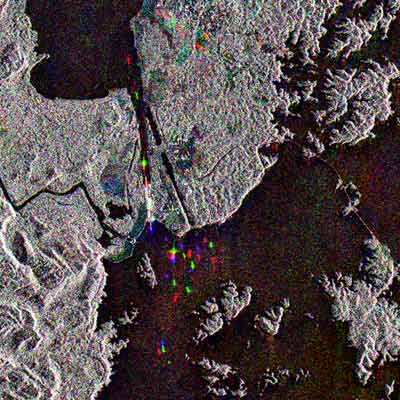 Appearing in this Envisat radar image like shining jewels, ships pass from the man-made Lake Gatun through the Panama Canal across Central America.
The colour in this image is due to it being a multitemporal composite, made up of three Advanced Synthetic Aperture Radar (ASAR) images acquired on different dates, with separate colours assigned to each acquisition to highlight differences between them: Red for 16 March, Green for 12 Jan and blue for 14 October 2004. The view was acquired in ASAR Image Mode Precision, with pixel sampling of 12.5 metres.


Explore planet Earth in near-real time

Have you ever wanted to track natural events in progress, such as fires, floods and volcanic eruptions, or simply explore the planet through the eyes of a satellite? ESA has created a website, MIRAVI, which gives access to the most recently acquired images from the world’s largest Earth Observation satellite, Envisat. MIRAVI, short for MERIS Images RApid VIsualisation, tracks Envisat around the globe, generates images from the raw data collected by Envisat’s optical instrument, MERIS, and provides them online within two hours. MIRAVI is free and requires no registration (Go).
Saturday, 16 December 2006
Brain development
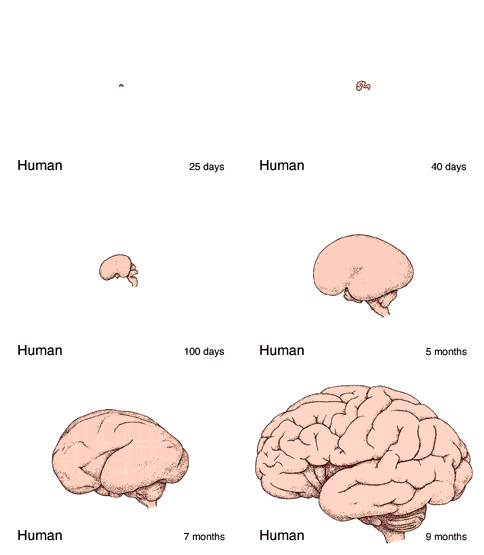 The embryonic and fetal brains of all mammals develop in similar ways. The embryonic spinal cord develops along common sequences and patterns. The nervous system emerges from a simple elongated tube of cells, called the notochord. The head (cranial) end of the embryonic tube expands and differentiates more robustly (than does the spinal end) into several clusters of cells which emerge as the forebrain (telencephalon and diencephalon), midbrain (mesencephalon) and hindbrain (metencephalon and myelencephalon) portions.
Please, compare to brain evolution.
Brain circuitry
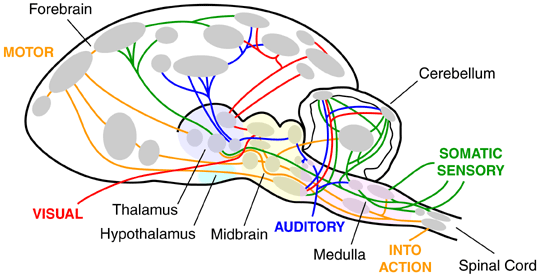
This diagram illustrates the principle that brain circuits travel up and down the neuroaxis, from one side of the brain to the other, as well as back and forth between many different brain components at several levels within the forebrain, thalamus, hypothalamus, midbrain, medulla, cerebellum and spinal cord.
 Why is it important to learn how brains are constructed?
For a brain to perform all the functions that it must do, it must: 1. Detect and locate the great variety of stimulus types, sources, and happenings in the environment; 2. Make sense of all these sensory events; 3. Respond to all these features by expressing an elaborate behavioral repertoire; and 4. Make judgments, learn, and think about all these things.
Over the last 50 years, a great number of neuronal cell groups, circuits and connections have been identified and named in the several different regions of the brain. In addition, the functions of these different nuclei and circuits have been identified. Moreover, the neuroanatomical and neurochemical mechanisms by which these circuits operated to produce and enable them to function effectively have begun to be clarified. But much remains to be done, and in the next two decades, it is estimated that modern technology will provide ever greater insight as to how the circuits of the brain perform the functions that they do.
 Why is it important to learn how brains are constructed?
For a brain to perform all the functions that it must do, it must: 1. Detect and locate the great variety of stimulus types, sources, and happenings in the environment; 2. Make sense of all these sensory events; 3. Respond to all these features by expressing an elaborate behavioral repertoire; and 4. Make judgments, learn, and think about all these things.
Over the last 50 years, a great number of neuronal cell groups, circuits and connections have been identified and named in the several different regions of the brain. In addition, the functions of these different nuclei and circuits have been identified. Moreover, the neuroanatomical and neurochemical mechanisms by which these circuits operated to produce and enable them to function effectively have begun to be clarified. But much remains to be done, and in the next two decades, it is estimated that modern technology will provide ever greater insight as to how the circuits of the brain perform the functions that they do.
Brain evolution
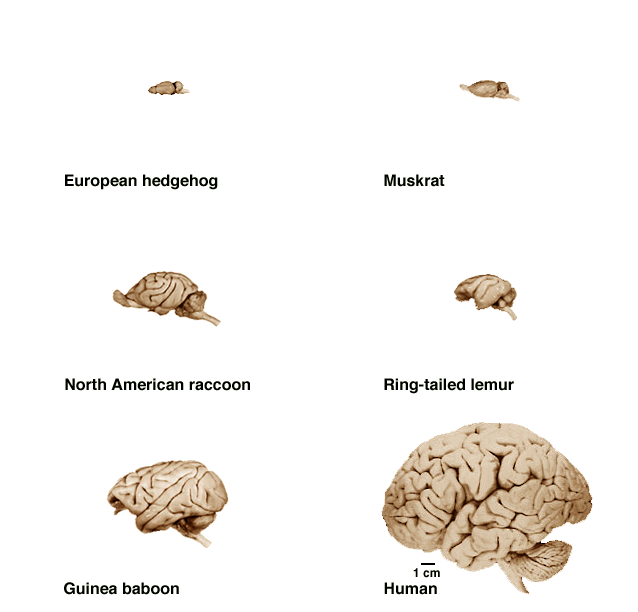
Evidence of brain evolution can be seen in various fields of biology, such as paleontology, ethology, behavioral biology, cognitive psychology, molecular biology and genetics.
Please, compare to brain development.
Friday, 15 December 2006
Silos Apocalypse
 This spectacular manuscript of Beatus of Liébana’s commentary on the Apocalypse survives in near perfect condition from the first decade of the 12th century. It was copied and illuminated in the Spanish monastery of Santo Domingo de Silos at a time when the monastery’s scriptorium was producing its finest work. Painted in brilliant colours and embellished with gold and silver leaf, its 106 striking miniatures illustrate the most extraordinary scenes in the Christian Bible - a triumph of artistic vision.
Its beauty and excellent state of preservation would alone make this an important manuscript. But there is more besides. It also contains one of the oldest Christian maps of the world. The map presents a picture of the Mediterranean world virtually unchanged since the 8th century, which in turn reflected an even older world view inherited from Roman times.
The map was intended to show the routes taken by the Christian missions of the early saints. East is at the top of the map, rather than the right as in modern maps. Adam and Eve are portrayed against a dark green background representing the verdant Garden of Eden. Beyond the Red Sea is a hint of an undiscovered fourth continent that some ancient thinkers – among them, Pliny, the first-century Roman writer – had suggested must exist in order to balance the known land masses of Europe, Asia and Africa.
Wednesday, 13 December 2006
Egyptian mummy mask

The ancient Egyptians performed mumification to transform the bodies of the dead into dwellings for the ba (spirit) in the afterlife. The seventy-day process purged the corpse of fluids that cause decay and endowed it with the attributes of gods such as Osiris and Ra, who had the power to renew human life eternally.An important part of the mummy was a helmet-like mask, which was placed over the head of the linen-wrapped body. Its youthful features were not intended as a likeness of the deceased, but projected an idealized image for their existence in the afterlife.This example has many of the typical features of these masks. It is made of cartonnage, a lightweight material formed from layers of linen coated with plaster. The gilded skin and the wig symbolize the wearer's divine status - the gods had flesh of gold and hair of the blue mineral lapis lazuli. The ornamental collar and the gilded winged scarab beetle on the top of the head promoted the resurrection of the deceased. Lastly, a spell from the Coffin Texts linked the mask's anatomy to that of powerful gods: 'Your forehead is that of Anubis, the nape of your neck is that of Horus, your locks of hair are those of Ptah-Sokar....' The mask also provided physical protection and could act as a substitute should the mummy's head lost or damaged.
Late 1st century BC-early 1st century ADFrom Abydos, Egypt (Greco-Roman Period).
Subscribe to:
Posts (Atom)