Showing posts with label Nature. Show all posts
Showing posts with label Nature. Show all posts
Wednesday, 27 March 2013

Tuesday, 23 March 2010
Nature by Numbers
A movie inspired on numbers, geometry and nature, by Cristóbal Vila. Go to www.etereaestudios.com for more info: theory behind, stills, screenshots, tutorials and workshops.
Saturday, 24 January 2009
Darwin Big Idea
 Darwin is the biggest ever exhibition about Charles Darwin. It celebrates Darwin's ideas and their impact for his 200th birthday in 2009. Discover the man and the revolutionary theory that changed our understanding of the world. See incredible, revealing and rare exhibits, some on display for the first time (more at The Natural History Museum, London.
Monday, 19 November 2007
Flying Snake
 The image of airborne snakes may seem like the stuff of nightmares (or a certain Hollywood movie), but in the jungles of South and Southeast Asia it is reality.Flying snake is a misnomer, since, barring a strong updraft, these animals can’t actually gain altitude. They’re gliders, using the speed of free fall and contortions of their bodies to catch the air and generate lift.Once thought to be more parachuters than gliders, recent scientific studies have revealed intricate details about how these limbless, tube-shaped creatures turn plummeting into piloting. To prepare for take-off, a flying snake will slither to the end of a branch, and dangle in a J shape. It propels itself from the branch with the lower half of its body, forms quickly into an S, and flattens to about twice its normal width, giving its normally round body a concave C shape which can trap air. By undulating back and forth, the snake can actually make turns. Flying snakes are technically better gliders than their more popular mammalian equivalents, the flying squirrels.There are five recognized species of flying snake, found from western India to the Indonesian archipelago. Knowledge of their behavior in the wild is limited, but they are thought to be highly arboreal, rarely descending from the canopy. The smallest species reach about 2 feet (61 centimeters) in length and the largest grow to 4 feet (1.2 meters).Their diets are variable depending on their range, but they are known to eat rodents, lizards, frogs, birds, and bats. They are mildly venomous snakes, but their tiny, fixed rear fangs make them harmless to humans.Scientists don’t know how often or exactly why flying snakes fly, but it’s likely they use their aerobatics to escape predators, to move from tree to tree without having to descend to the forest floor, and possibly even to hunt prey.One species, the twin-barred tree snake, is thought to be rare in its range, but flying snakes are otherwise quite abundant and have no special conservation status.
Sunday, 16 September 2007


Monday, 2 July 2007
Simple Creatures, Intriguing Finds
 Researchers look to fruit flies and tiny worms for greater understanding of neurodegenrative diseases such as Alzheimer's and Parkinson's. Fruit flies have many genes in common with higher animals, including humans. Researchers can easily transplant genes from humans into fruit flies. Finding mutations and observing the characteristics they produce are easier in fruit flies than in other types of animals.
Feany’s laboratory has bred a strain of the fruit fly Drosophila melanogaster that models Parkinson’s disease. Her team implanted mutant genes in the flies for a protein called alpha-synuclein.
Flies carrying the mutant genes lose dopamine-producing neurons in the brain’s substantia nigra, just as humans with Parkinson’s do. Also, fibrous bundles of alpha-synuclein form in the insects’ neurons. Bundles of the same structure and composition (called Lewy bodies) develop in the brain cells of people with Parkinson’s.
Cellular changes in the flies correlate with behavioral changes. Normal fruit flies climb up the sides of plastic vials. Middle-aged flies carrying the transplanted, mutant gene lose that ability.
Wednesday, 3 January 2007
Hurricane Katrina simulation

Click on image to view movie.
Orange represents ocean temperatures at 82 degrees Fahrenheit or higher. This is the temperature required for hurricanes to form. The bottom left window shows wind analysis model data from NASA's Modeling, Analysis, and Prediction (MAP '05) program. The top right window shows rainfall accumulation for Hurricane Katrina from the TRMM spacecraft. The bottom right window shows energy-releasing deep convective clouds (as high as 16 km) in the eyewall of Hurricane Katrina. These clouds, called hot towers, formed on August 28 while the storm was intensifying to a category 5 hurricane.
Sunday, 31 December 2006
Frogs lying
 If you happen across a pond full of croaking green frogs, listen carefully. Some of them may be lying. A croak is how male green frogs tell other frogs how big they are. The bigger the male, the deeper the croak. The sound of a big male is enough to scare off other males from challenging him for his territory.
While most croaks are honest, some are not. Some small males lower their voices to make themselves sound bigger. Their big-bodied croaks intimidate frogs that would beat them in a fair fight.
Sunday, 24 December 2006
Satellite portrait of global plant growth will aid climate research
An ambitious ESA (European Space Agency) project to chart ten years in the life of the Earth's vegetation has reached a midway point, with participants and end-users having met to review progress so far. Harnessing many terabytes of satellite data, the GLOBCARBON project is intended to hone the accuracy of climate change forecasting. GLOBCARBON involves the development of a service to generate fully calibrated estimates of land products based on a variety of Earth Observation data, suitable for assimilation into sophisticated software simulations of the planet created by the global carbon modelling community.
The service is focused on the generation of various global estimates of aspects of terrestrial vegetation: the number, location and area of fire-affected land, known as Burnt Area Estimates (BAE), the area of green leaf exposed to incoming sunlight for photosynthesis, known as Leaf Area Index (LAI), the sunlight actually absorbed for photosynthesis, known as the Fraction of Absorbed Photosynthetically Active Radiation (fAPAR) and the Vegetation Growth Cycle (VGC).
The service is focused on the generation of various global estimates of aspects of terrestrial vegetation: the number, location and area of fire-affected land, known as Burnt Area Estimates (BAE), the area of green leaf exposed to incoming sunlight for photosynthesis, known as Leaf Area Index (LAI), the sunlight actually absorbed for photosynthesis, known as the Fraction of Absorbed Photosynthetically Active Radiation (fAPAR) and the Vegetation Growth Cycle (VGC).
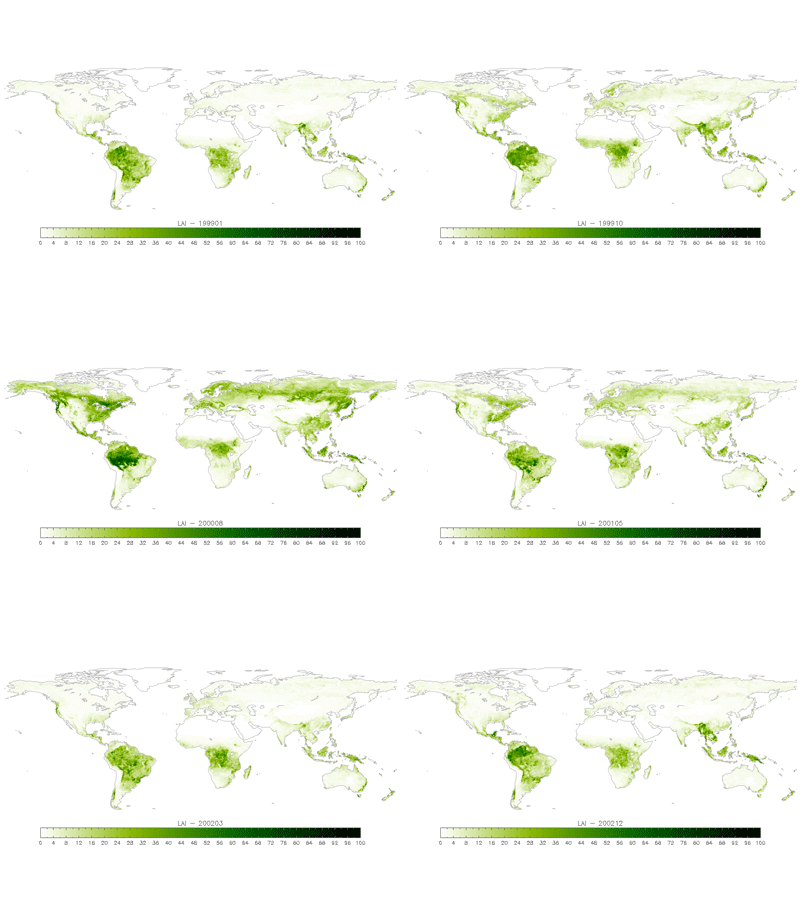
Worldwide leaf area index (LAI)


Tuesday, 19 December 2006
Earth from above

The "Earth from above Project" makes possible to draw up a true portrait of our planet which unceasingly continues to be updated. The web invites each one to reflect on engagement in favour of the sustainable development. The legends hich accompany the images inform the reader of the exposures the Earth seen on the sky of the alarming ecological evolutions (Visit the Menu and search by country).
Wednesday, 13 December 2006
Eye-to-eye

This white-legged damselfly posed one May evening for more than an hour on symmetrically crossed grasses. It seemed as transfixed by the photographer as he was by it. ‘After a couple of photos from a distance,’ says Theo, ‘I crept closer and closer, trying not to make any unexpected movements. An hour or so and many shots later, I was really close. But it still maintained eye contact while I fired off shot after shot.’ The resulting detail reveals not only its beautiful colours but also its spiked hair and ‘goatee’ beard, together with its armoury of sensory leg bristles.
Ghost frog
 Many species of frog in Costa Rica have disappeared over the past couple of decades, probably a combination of a deadly fungus and the stresses of climate change. Ghost glass frogs are still relatively widespread, but are difficult to find. Edwin’s guide hadn’t seen one for a year, and so the discovery was even more exciting than the mountain lion footprints in the mud nearby. ‘I stood in a stream to get as close as I could,’ says Edwin. ‘The frog remained motionless as I took its portrait, completely confident in its ability to morph into the plant it was attached to.’ Ghost glass frogs get their name from the transparent skin on their bellies through which you can see their organs and even their circulating blood.
Subscribe to:
Posts (Atom)