Showing posts with label Human biology. Show all posts
Showing posts with label Human biology. Show all posts
Wednesday, 27 March 2013

Friday, 24 August 2007
Hall of Human Origins
 All species consist of individuals that differ at some level. In Homo sapiens, population diversity arose as small groups occupied varied environments around the world. Localized populations changed due to genetic drift and natural selection. For example, some populations eventually showed more susceptibility to certain diseases, or more ability to digest certain foods. Superficial differences in stature and hair, eye, and skin color also arose among individuals and populations.Although these population changes take place at a genetic level, it does not mean that genes define "race." Race is cultural and social, not biological.Small, isolated groups are less and less prevalent in the human population. Our population is now abundant, consisting of larger, varied groups that intermingle and overlap. Since humans reproduce both within and between groups, we constantly mix genetic information. As a result, genetic differences between people of the same "racial" group can be greater than the those between people of two different groups. Furthermore, influences other than genes—such as hormones and environmental factors—also contribute to individual variation (go).
Tuesday, 21 August 2007
The Secret Life of the Brain
 THE SECRET LIFE OF THE BRAIN reveals the fascinating processes involved in brain development across a lifetime. The five-part series, which will premiere nationally on PBS in winter 2002, informs viewers of exciting new information in the brain sciences, introduces the foremost researchers in the field, and utilizes dynamic visual imagery and compelling human stories to help a general audience understand otherwise difficult scientific concepts (go).
Monday, 2 July 2007
Simple Creatures, Intriguing Finds
 Researchers look to fruit flies and tiny worms for greater understanding of neurodegenrative diseases such as Alzheimer's and Parkinson's. Fruit flies have many genes in common with higher animals, including humans. Researchers can easily transplant genes from humans into fruit flies. Finding mutations and observing the characteristics they produce are easier in fruit flies than in other types of animals.
Feany’s laboratory has bred a strain of the fruit fly Drosophila melanogaster that models Parkinson’s disease. Her team implanted mutant genes in the flies for a protein called alpha-synuclein.
Flies carrying the mutant genes lose dopamine-producing neurons in the brain’s substantia nigra, just as humans with Parkinson’s do. Also, fibrous bundles of alpha-synuclein form in the insects’ neurons. Bundles of the same structure and composition (called Lewy bodies) develop in the brain cells of people with Parkinson’s.
Cellular changes in the flies correlate with behavioral changes. Normal fruit flies climb up the sides of plastic vials. Middle-aged flies carrying the transplanted, mutant gene lose that ability.
Friday, 23 March 2007
What makes us human?
 Music, art, language and technology are just a few of the ways we shape our surroundings and define who we are. Although they vary over time and from culture to culture, these forms of expression reveal an inventive spirit shared by all humans.
Weighing only about three pounds when fully grown, your brain stores your every memory, generates your every thought and feeling and allows you to manage your world. More than any other part of the body, the human brain—and its capacity for symbolic thought—sets us apart from all other species. 
Although the human brain reached its current size some 150,000 years ago, the first evidence of symbolic thought didn't appear until tens of thousands of years later. Our symbolic awakening occurred when modern humans began to use their brains differently (read more).
Although the human brain reached its current size some 150,000 years ago, the first evidence of symbolic thought didn't appear until tens of thousands of years later. Our symbolic awakening occurred when modern humans began to use their brains differently (read more).
Sunday, 4 March 2007
Neurogenesis in the Adult Olfactory Bulb
Active neurogenesis from neural progenitors continues throughout life in discrete regions of the central nervous system of most mammals. However, human adult neurogenesis is still a contentious issue. Signs of adult neurogenesis have been reported in the hippocampus, but a second neurogenic niche described in rodents has not been found in recent human studies. Curtis et al. have just published a paper in Science not only describing this missing rostral migratory stream in great detail but also showing that it is organized around a tubular extension of the lateral ventricle that reaches into the olfactory bulb. (view figures).

Sunday, 14 January 2007
Book of Neuroscience
 An Introduction for Young Students - is available electronically in English, Mandarin and Spanish from the British Neuroscience Association. The book is idea for those with little previous knowledge of the brain and is a wonderfully neat and concise 'primer' of neuroscience, touching on everything from development to drug addiction. A number of leading neuroscientists in the UK have contributed chapters describing their field of expertise in a simple yet imaginative and visually appealing way (View Full Text).
Friday, 12 January 2007
Neural substrates of envisioning the future

Cortical regions exhibiting activity differences and similarities during past and future thought. (A–D) Percent signal change for representative regions showing a significant interaction such that imagining of future events (SF) led to greater activation over the 10-modeled timepoints than did recollecting oneself in the past (SR). Both self-related tasks also led to greater activity than a control task involving imagery of another person participating in similar events (CI). (E–H) Percent signal change for selected regions showing a statistically indistinguishable pattern of activity across time while subjects envisioned their personal future (SF) and recollected the past (SR) in response to a series of event cues (e.g., Birthday). Imagining a familiar individual in similar scenarios (CI) resulted in a pattern of activity different from both the past and future tasks (View Full Text Paper).
Sunday, 31 December 2006
Postetanic potentiation
 Some processes in nervous tissue are essentially discontinuous in nature, others, like heat and carbon dioxide production, and positive after-potential, are cumulative; they tend to develop in some relation to the number of impulses carried, not infrequently to appear in measurable form only after a number of actions have been compressed into a limited time. In such conditions of activity not only are cumulative processes demonstrable in nerve, but indications of their influence may be found in the altered responsiveness of simple synaptic relays and of neuromuscular junctions. The usual sequel to a period of tetanic stimulation in junctional tissues is a more or less prolonged increase in the transmitted response to standard, iterative, but infrequently elicited pre-junctional nerve volleys into which train of volleys the tetanus has been interpolated (2, 7, 10, 11, 23, 35, etc.). The observed phenomena have been called post-tetanic facilitation, or post-tetanic potentiation; the latter designation is to be preferred. This article by Lloyd, 1949 describes this process (full access).
Visual system by Descartes
 Figure 63 of De Homine (1662), by René Descartes. This figure shows how the light enters and makes images on the retina. The nervous pathway goes from the optic chiasma to the pineal gland. It moves toward the arm and induces the muscle contraction to project the arm onto the AC arrow.
Saturday, 16 December 2006
Brain circuitry
This diagram illustrates the principle that brain circuits travel up and down the neuroaxis, from one side of the brain to the other, as well as back and forth between many different brain components at several levels within the forebrain, thalamus, hypothalamus, midbrain, medulla, cerebellum and spinal cord.
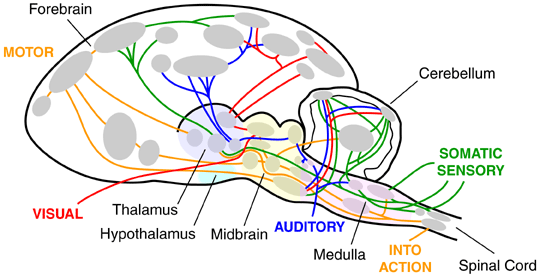 Why is it important to learn how brains are constructed?
For a brain to perform all the functions that it must do, it must: 1. Detect and locate the great variety of stimulus types, sources, and happenings in the environment; 2. Make sense of all these sensory events; 3. Respond to all these features by expressing an elaborate behavioral repertoire; and 4. Make judgments, learn, and think about all these things.
Over the last 50 years, a great number of neuronal cell groups, circuits and connections have been identified and named in the several different regions of the brain. In addition, the functions of these different nuclei and circuits have been identified. Moreover, the neuroanatomical and neurochemical mechanisms by which these circuits operated to produce and enable them to function effectively have begun to be clarified. But much remains to be done, and in the next two decades, it is estimated that modern technology will provide ever greater insight as to how the circuits of the brain perform the functions that they do.
Why is it important to learn how brains are constructed?For a brain to perform all the functions that it must do, it must: 1. Detect and locate the great variety of stimulus types, sources, and happenings in the environment; 2. Make sense of all these sensory events; 3. Respond to all these features by expressing an elaborate behavioral repertoire; and 4. Make judgments, learn, and think about all these things.
Over the last 50 years, a great number of neuronal cell groups, circuits and connections have been identified and named in the several different regions of the brain. In addition, the functions of these different nuclei and circuits have been identified. Moreover, the neuroanatomical and neurochemical mechanisms by which these circuits operated to produce and enable them to function effectively have begun to be clarified. But much remains to be done, and in the next two decades, it is estimated that modern technology will provide ever greater insight as to how the circuits of the brain perform the functions that they do.
Sunday, 10 December 2006
Vesalius's stunning 16th century anatomy

Would you like to leaf through Humani corporis fabrica by Vesalius? (Go)

This aplication uses Turning the Pages™ and Shockwave plug-in, which can be downloaded from the Adobe website, to simulate the action of turning the pages of a real book. The volumes may not open if you block popups on your computer.
How did humans start talking?
 Scientists disagree over how human language arose. Some think that our human ancestors started talking as soon as their brains became large and sophisticated enough. Others think that language evolved slowly, from the gestures and sounds used by our earlier ape-like ancestors. To test whether present-day apes have the ability to communicate using language, researchers have tried teaching them different kinds of language.
When did humans start talking?
 Human language probably started to develop around 100,000 years ago. Before then, human jaws, mouths and voice boxes were the wrong shape to form words. Some scientists think that all human languages arose from a common language spoken by our ancestors in Africa. There are over 5000 different languages in the world today, although over 90 per cent of these are nearly extinct.
Language
 Human beings are the great communicators of the animal world. They are the only living creatures that use language - words or symbols that represent objects, actions, qualities, feelings and ideas. Other animals communicate in much less complex ways.
Emotions
 Everyone feels happiness, surprise, fear, sadness, disgust and anger at some time - these are the six basic emotions. There are over 600 words in English to describe them and we use 42 muscles in our faces to express them.
How does our brain work?
 Our brain is the hub of your nervous system. It is made up of 100 billion nerve cells - about the same as the number of trees in the Amazon rainforest. Each cell is connected to around 10,000 others. So the total number of connections in our brain is the same as the number of leaves in the rainforest - about 1000 trillion.
Subscribe to:
Posts (Atom)