Showing posts with label Info. Show all posts

Sunday, 14 January 2007

Historical Wonders of Sanxingdui

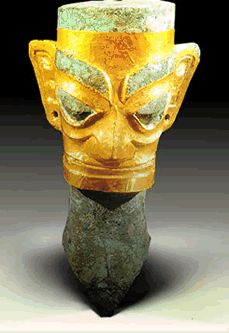
The site of Sanxingdui, located in the city of Guanghan, 40 km from Chengdu, Sichuan Province (China), is recognized as one of the most important ancient remains in the world for its vast size, lengthy period and enriched cultural contents.
The first Sanxingdui relics were discovered by a farmer in 1929 and excavation has continued ever since. During this period, generations of archaeologists have worked on the discovery and research of the Sanxingdui culture. In 1986, two major sacrificial pits were found and they aroused widespread academic attention around the world.
The Sanxingdui finds are exciting, but they remain enigmatic. No texts have been found, nor is there any mention of this culture in the records of other countries. Analysis of lead and other elements in the bronzes indicates sources similar to those of other cultures along the lower reaches of the Yangtze River. At this point, however, the unique culture that produced these artifacts remains a mystery (View Pictures).

Monday, 25 December 2006

Statue of Amun with features of Tutankhamun

Amun typically appears as a man wearing a tall, double-plumed headdress. His tall headdress is missing from this statue, but his crown bears traces of gilding. Amun wears the false beard of a deity, an elaborately beaded broad collar, and a short kilt decorated on the belt with a tyet-amulet, a symbol related both to the goddess Isis and to the ankh, the hieroglyph meaning “life”. The god also holds ankhs indicating his immortality. His hands, which have been intentionally cut back, may represent a deliberate alteration to allow the statue to fit into a shrine or a portable ceremonial boat used to carry it in processions.
Provenance unknown, possibly Thebes, late Dynasty 18-early Dynasty 19 (1332-1292 BCE), greywacke.

The Rosetta Stone

What is the Rosetta Stone?
The Rosetta Stone is a stone with writing on it in two languages (Egyptian and Greek), using three scripts (hieroglyphic, demotic and Greek).
Why is it in three different scripts?
The Rosetta Stone is written in three scripts because when it was written, there were three scripts being used in Egypt.
The first was hieroglyphic which was the script used for important or religious documents.
Detail of hieroglyphic and demotic script on the Rosetta Stone
The second was demotic which was the common script of Egypt.
The third was Greek which was the language of the rulers of Egypt at that time.
The Rosetta Stone was written in all three scripts so that the priests, government officials and rulers of Egypt could read what it said.
When was the Rosetta Stone made?
The Rosetta Stone was carved in 196 B.C..
When was the Rosetta Stone found?
The Rosetta Stone was found in 1799.
Who found the Rosetta Stone?
The Rosetta Stone was found by French soldiers who were rebuilding a fort in Egypt.
Where was the Rosetta Stone found?
The Rosetta Stone was found in a small village in the Delta called Rosetta (Rashid).
Why is it called the Rosetta Stone?
It is called the Rosetta Stone because it was discovered in a town called Rosetta (Rashid).
What does the Rosetta Stone say?
The Rosetta Stone is a text written by a group of priests in Egypt to honour the Egyptian pharaoh. It lists all of the things that the pharaoh has done that are good for the priests and the people of Egypt.
Who deciphered hieroglyphs? Many people worked on deciphering hieroglyphs over several hundred years. However, the structure of the script was very difficult to work out.
After many years of studying the Rosetta Stone and other examples of ancient Egyptian writing, Jean-François Champollion deciphered hieroglyphs in 1822.
How did Champollion decipher hieroglyphs?
Champollion could read both Greek and coptic.
He was able to figure out what the seven demotic signs in coptic were. By looking at how these signs were used in coptic he was able to work out what they stood for. Then he began tracing these demotic signs back to hieroglyphic signs.
By working out what some hieroglyphs stood for, he could make educated guesses about what the other hieroglyphs stood for.

Sunday, 24 December 2006

Satellite portrait of global plant growth will aid climate research

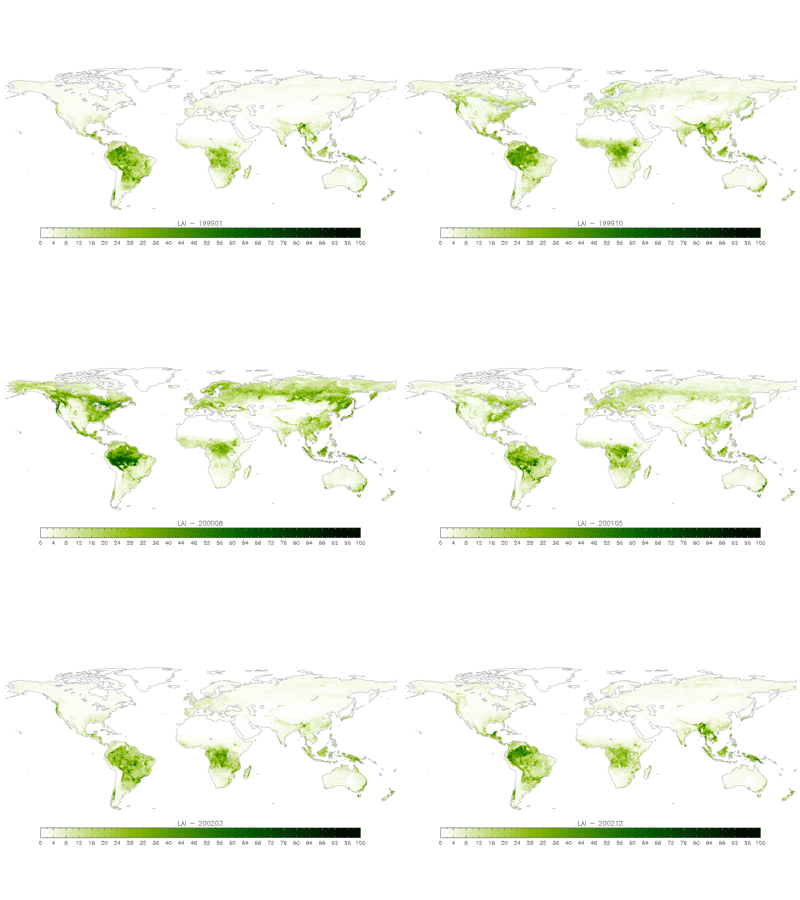
An ambitious ESA (European Space Agency) project to chart ten years in the life of the Earth's vegetation has reached a midway point, with participants and end-users having met to review progress so far. Harnessing many terabytes of satellite data, the GLOBCARBON project is intended to hone the accuracy of climate change forecasting. GLOBCARBON involves the development of a service to generate fully calibrated estimates of land products based on a variety of Earth Observation data, suitable for assimilation into sophisticated software simulations of the planet created by the global carbon modelling community.
The service is focused on the generation of various global estimates of aspects of terrestrial vegetation: the number, location and area of fire-affected land, known as Burnt Area Estimates (BAE), the area of green leaf exposed to incoming sunlight for photosynthesis, known as Leaf Area Index (LAI), the sunlight actually absorbed for photosynthesis, known as the Fraction of Absorbed Photosynthetically Active Radiation (fAPAR) and the Vegetation Growth Cycle (VGC).

Worldwide leaf area index (LAI)

Saturday, 23 December 2006

Hubble Reopens Eye on the Universe

In its first glimpse of the heavens following the successful December 1999 servicing mission, NASA's Hubble Space Telescope captured a majestic view of a planetary nebula, the glowing remains of a dying, Sun-like star. This stellar relic, first spied by William Herschel in 1787, is nicknamed the "Eskimo" Nebula (NGC 2392) because, when viewed through ground-based telescopes, it resembles a face surrounded by a fur parka. In this Hubble telescope image, the "parka" is really a disk of material embellished with a ring of comet-shaped objects, with their tails streaming away from the central, dying star. The Eskimo's "face" also contains some fascinating details. Although this bright central region resembles a ball of twine, it is, in reality, a bubble of material being blown into space by the central star's intense "wind" of high-speed material. In this photo, one bubble lies in front of the other, obscuring part of the second lobe. Scientists believe that a ring of dense material around the star's equator, ejected during its red giant phase, created the nebula's shape. The bubbles are not smooth like balloons but have filaments of denser matter. Each bubble is about 1 light-year long and about half a light-year wide. Scientists are still puzzled about the origin of the comet-shaped features in the "parka." One possible explanation is that these objects formed from a collision of slow-and fast-moving gases. The Eskimo Nebula is about 5,000 light-years from Earth in the constellation Gemini. The picture was taken Jan. 10 and 11, 2000, with the Wide Field and Planetary Camera 2. The nebula's glowing gases produce the colors in this image: nitrogen (red), hydrogen (green), oxygen (blue), and helium (violet).

Saturday, 16 December 2006

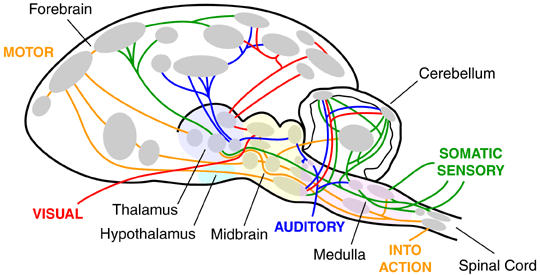
Brain circuitry

This diagram illustrates the principle that brain circuits travel up and down the neuroaxis, from one side of the brain to the other, as well as back and forth between many different brain components at several levels within the forebrain, thalamus, hypothalamus, midbrain, medulla, cerebellum and spinal cord.
Why is it important to learn how brains are constructed?
For a brain to perform all the functions that it must do, it must: 1. Detect and locate the great variety of stimulus types, sources, and happenings in the environment; 2. Make sense of all these sensory events; 3. Respond to all these features by expressing an elaborate behavioral repertoire; and 4. Make judgments, learn, and think about all these things.
Over the last 50 years, a great number of neuronal cell groups, circuits and connections have been identified and named in the several different regions of the brain. In addition, the functions of these different nuclei and circuits have been identified. Moreover, the neuroanatomical and neurochemical mechanisms by which these circuits operated to produce and enable them to function effectively have begun to be clarified. But much remains to be done, and in the next two decades, it is estimated that modern technology will provide ever greater insight as to how the circuits of the brain perform the functions that they do.

Sunday, 10 December 2006

How did humans start talking?

Scientists disagree over how human language arose. Some think that our human ancestors started talking as soon as their brains became large and sophisticated enough. Others think that language evolved slowly, from the gestures and sounds used by our earlier ape-like ancestors. To test whether present-day apes have the ability to communicate using language, researchers have tried teaching them different kinds of language.

When did humans start talking?

Human language probably started to develop around 100,000 years ago. Before then, human jaws, mouths and voice boxes were the wrong shape to form words. Some scientists think that all human languages arose from a common language spoken by our ancestors in Africa. There are over 5000 different languages in the world today, although over 90 per cent of these are nearly extinct.

Language

Human beings are the great communicators of the animal world. They are the only living creatures that use language - words or symbols that represent objects, actions, qualities, feelings and ideas. Other animals communicate in much less complex ways.

Emotions

Everyone feels happiness, surprise, fear, sadness, disgust and anger at some time - these are the six basic emotions. There are over 600 words in English to describe them and we use 42 muscles in our faces to express them.

How does our brain work?

Our brain is the hub of your nervous system. It is made up of 100 billion nerve cells - about the same as the number of trees in the Amazon rainforest. Each cell is connected to around 10,000 others. So the total number of connections in our brain is the same as the number of leaves in the rainforest - about 1000 trillion.