Showing posts with label History. Show all posts

Thursday, 28 January 2016

ChronoZoom is aimed at visualizing the history of everything

ChronoZoom is an open source community project owned by the Outercurve Foundation and dedicated to visualizing the history of everything.  ChronoZoom bridges the gap between the humanities and sciences using a notion of “Big History” to easily understand all this information. This project has been funded and supported by Microsoft Research Connections in collaboration with University California at Berkeley, Moscow State University and University of Washington Information School (iSchool), and The Center for Web and Data Science (WDS) departments.

You can browse through all of history on ChronoZoom to find data in the form of articles, images, video, sound, and other multimedia. ChronoZoom links together a wealth of information that has been curated by experts and enthusiasts to tell important stories from history. By drawing upon the latest discoveries from many different disciplines, you can visualize the temporal relationships between events, trends, and themes. Some of the disciplines that contribute information to ChronoZoom include biology, astronomy, geology, climatology, prehistory, archeology, anthropology, economics, cosmology, natural history, and population and environmental studies.

Tuesday, 12 October 2010

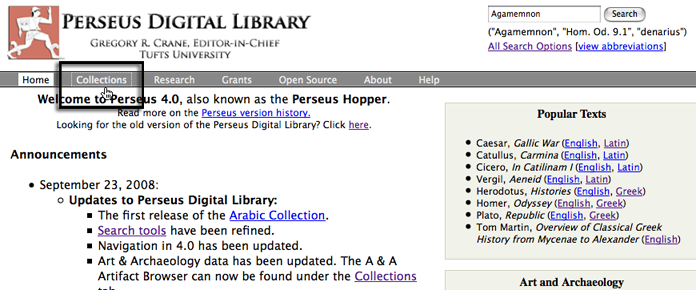
Perseus Digital Library

The Perseus Project is an evolving digital library of resources for the study of the humanities. It is aimed to perform research on developing tools to provide users with improved access to various types of materials. Past work has focused on building and linking together collections. Current work considers ways of developing and refining tools for presentation of the materials in the Perseus DL.

You can now view the places mentioned in the Perseus Digital Library by collection or text through the Google Maps interface. Links to view places in a text can be found on a text page, in the Places box.

Wednesday, 2 June 2010

Trailblazing

The Trailblazing website provides a timeline with key articles and historical events mapped out. Very nice and well worth spending a lunch-hour perusing!

Saturday, 4 October 2008

The Collegiate Church of Saint Isidoro

At the northeast side of the roman encampment Legio VII Gemina (Leon) (now in Spain), by the camp wall, King Sancho the Fat (dead in 966), son of Ramiro 2nd, built a monastery for sheltering the rests of the martyr boy from Cordoba, St. Pelayo (we can see a sculpture of him in the front of the church). Her sister, a nun called Elvira Ramirez, moved with all the nuns of her elder monastery, Palat del Rey, to the new one. In the last Xth century, due to the arrival of Almanzor's army, the nuns went to Oviedo for refuge. The monastery of St. Pelayo in Leon was razed by the Arabic chief troops. King Alfonso the Vth (999-1027) rebuilt the monastery using very poor materials, like clay and bricks. Once more, a community of nuns established there, for taking care of the Royal cemetery, where the King had moved the rests of his predecessors, who were dispersed along various kingdom churches; even his parents's, Vermudo the IInd and Elvira.

The daughter of Alfonso the Vth, Doña Sancha, first infant and after the Queen herself, tried to exalt the monastery to the highest dignity, helped by her husband, King Fernando the Ist (1037-1065).

They rebuilt the elder brick monastery out of stone and so began the romanic style in their kingdom. They choose the portic of the church as a cemetery and ordered to be buried there. .


They wanted to dignify their church with relevant saints relics; they achieved the moving of St. Isidoro's corpse from Sevilla and St. Vicente's from Avila. They made an extraordinary feast in december, 21st, 1063, and next day they celebrated the moving of St. Isidoro. For this special event, they made splendid donations, jewels and ornaments, that we know nowadays as the Treasure of Leon.

Fernando and Sancha's daughter, infant Urraca Fernandez (dead in 1101), enlarged the church and made splendid donations, like the well known chalice. Another infant, Doña Sancha Raimundez (dead in 1159), with her brother, Emperor Alfonso the VIIth, continued the works in the elder church, began by her grand aunt Doña Urraca, and consecrated the new church in 1149. A year before they had substituted the benedictine female comunity in the monastery by an ordinary prebendaries Council. They ruled the temple and the abbey until 1956, when the council was changed into a secular priests institution, and since then it takes care of the liturgical and intellectual life of the Collegiate Church, the Temple, the Museums open to thousands of visitors, both national and foreign, the Archives and the Library at the disposal of researchers, the Isidorian Editorial and Bookstore, with the main purpose of divulging the history and the art the Collegiate Church and the life of Saint Isidoro.

Wednesday, 24 September 2008

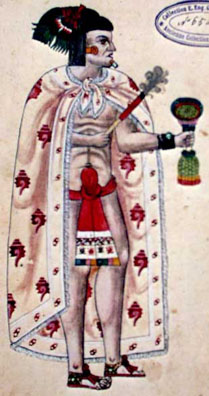
Codex Ixtlilxochitl

This is a manuscript with illustrations on European paper in folio, text in the Spanish language and is a fragment of a codex attributed by Leon y Parma to Don Fernando de Alva Ixtlilxochitl who was a "nobleman" of the Confederation of Culhua Mexica ("Aztec Empire") and the outstanding native historian of the early years of the Spanish Conquest. The codex deals with people and events of the pre-Conquest "Aztec Empire", which Ixtlilxochitl remembered. This will, naturally, be indispensible for any complete Latin American Library.

Sunday, 17 February 2008

Atlas of Human History

Where do you really come from? And how did you get to where you live today? DNA studies suggest that all humans today descend from a group of African ancestors who—about 60,000 years ago—began a remarkable journey.
The Genographic Project is seeking to chart new knowledge about the migratory history of the human species by using sophisticated laboratory and computer analysis of DNA contributed by hundreds of thousands of people from around the world. In this unprecedented and real-time research effort, the Genographic Project is closing the gaps of what science knows today about humankind's ancient migration stories.
The Genographic Project is a five-year research partnership led by National Geographic Explorer-in-Residence Dr. Spencer Wells. Dr. Wells and a team of renowned international scientists and IBM researchers, are using cutting-edge genetic and computational technologies to analyze historical patterns in DNA from participants around the world to better understand our human genetic roots. The three components of the project are: to gather field research data in collaboration with indigenous and traditional peoples around the world; to invite the general public to join the project by purchasing a Genographic Project Public Participation Kit; and to use proceeds from Genographic Public Participation Kit sales to further field research and the Genographic Legacy Fund which in turn supports indigenous conservation and revitalization projects. The Project is anonymous, non-medical, non-political, non-profit and non-commercial and all results will be placed in the public domain following scientific peer publication.
Enter

Wednesday, 11 July 2007

Sunday, 14 January 2007

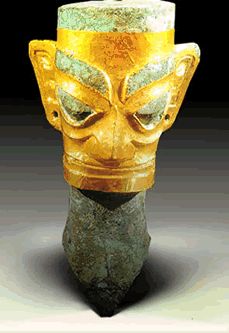
Historical Wonders of Sanxingdui

The site of Sanxingdui, located in the city of Guanghan, 40 km from Chengdu, Sichuan Province (China), is recognized as one of the most important ancient remains in the world for its vast size, lengthy period and enriched cultural contents.
The first Sanxingdui relics were discovered by a farmer in 1929 and excavation has continued ever since. During this period, generations of archaeologists have worked on the discovery and research of the Sanxingdui culture. In 1986, two major sacrificial pits were found and they aroused widespread academic attention around the world.
The Sanxingdui finds are exciting, but they remain enigmatic. No texts have been found, nor is there any mention of this culture in the records of other countries. Analysis of lead and other elements in the bronzes indicates sources similar to those of other cultures along the lower reaches of the Yangtze River. At this point, however, the unique culture that produced these artifacts remains a mystery (View Pictures).

Tuesday, 2 January 2007

Cave Painting 15,000-10,000 BC

Wounded bison attacking a man. c. 15,000-10,000 BC. Bison length 43 in. (110 cm) Lascaux, France

The mysterious Cycladic civilization

The Cup-Bearer, a Cycladic figurine of unknown provenance dating between 2800-2200 B.C.. A new discovery of smashed marble figurines on an uninhabited Aegean Sea islet has shed new light on the mysterious Cycladic civilization, whose strikingly modern figurines are prized exhibits in museums and collections worldwide.

Monday, 25 December 2006

Statue of Amun with features of Tutankhamun

Amun typically appears as a man wearing a tall, double-plumed headdress. His tall headdress is missing from this statue, but his crown bears traces of gilding. Amun wears the false beard of a deity, an elaborately beaded broad collar, and a short kilt decorated on the belt with a tyet-amulet, a symbol related both to the goddess Isis and to the ankh, the hieroglyph meaning “life”. The god also holds ankhs indicating his immortality. His hands, which have been intentionally cut back, may represent a deliberate alteration to allow the statue to fit into a shrine or a portable ceremonial boat used to carry it in processions.
Provenance unknown, possibly Thebes, late Dynasty 18-early Dynasty 19 (1332-1292 BCE), greywacke.

The Rosetta Stone

What is the Rosetta Stone?
The Rosetta Stone is a stone with writing on it in two languages (Egyptian and Greek), using three scripts (hieroglyphic, demotic and Greek).
Why is it in three different scripts?
The Rosetta Stone is written in three scripts because when it was written, there were three scripts being used in Egypt.
The first was hieroglyphic which was the script used for important or religious documents.
Detail of hieroglyphic and demotic script on the Rosetta Stone
The second was demotic which was the common script of Egypt.
The third was Greek which was the language of the rulers of Egypt at that time.
The Rosetta Stone was written in all three scripts so that the priests, government officials and rulers of Egypt could read what it said.
When was the Rosetta Stone made?
The Rosetta Stone was carved in 196 B.C..
When was the Rosetta Stone found?
The Rosetta Stone was found in 1799.
Who found the Rosetta Stone?
The Rosetta Stone was found by French soldiers who were rebuilding a fort in Egypt.
Where was the Rosetta Stone found?
The Rosetta Stone was found in a small village in the Delta called Rosetta (Rashid).
Why is it called the Rosetta Stone?
It is called the Rosetta Stone because it was discovered in a town called Rosetta (Rashid).
What does the Rosetta Stone say?
The Rosetta Stone is a text written by a group of priests in Egypt to honour the Egyptian pharaoh. It lists all of the things that the pharaoh has done that are good for the priests and the people of Egypt.
Who deciphered hieroglyphs? Many people worked on deciphering hieroglyphs over several hundred years. However, the structure of the script was very difficult to work out.
After many years of studying the Rosetta Stone and other examples of ancient Egyptian writing, Jean-François Champollion deciphered hieroglyphs in 1822.
How did Champollion decipher hieroglyphs?
Champollion could read both Greek and coptic.
He was able to figure out what the seven demotic signs in coptic were. By looking at how these signs were used in coptic he was able to work out what they stood for. Then he began tracing these demotic signs back to hieroglyphic signs.
By working out what some hieroglyphs stood for, he could make educated guesses about what the other hieroglyphs stood for.


Sunday, 24 December 2006

Proceedings of the trial against Galileo Galilei

Full access to the original proceedings of the trial against Galileo Galilei.
Rome, 1616‑1633. Paper volume, 338x225 mm, ff. 228: modern green cardboard binding, with a parchment back (View).


Wednesday, 13 December 2006

The earliest dated European astrolabe

The astrolabe is a multi-functional instrument which enables the user to perform such diverse tasks as timekeeping at day and night, surveying, determining latitude, and casting horoscopes.
Geoffrey Chaucer (about 1342-1400), better known for his Canterbury Tales, also wrote a treatise on the astrolabe which was widely disseminated. The type of astrolabe he described matches the features of this instrument, with its distinctive Y-shaped rete, a dog's head as a star-pointer for Sirius (known as the dog-star), and other star-pointers in the shape of birds. The frame around the circumference has a dragon's head and tail respectively at the ends.
Three of the saints mentioned in the calendrical list on the back are of particular English significance, and one of the latitude plates is marked for Oxford, while the others are laid out for Jerusalem, 'Babilonie', Rome, Montpellier, and Paris.

Turquoise mosaic of a double-headed serpent

This ornament was probably worn on ceremonial occasions as a pectoral (an ornament worn on the chest). It is carved in wood and covered with turquoise mosaic. The eye sockets were probably inlaid with iron pyrites and shell. Red and white shell was used to add details to the nose and mouth of both serpent heads. The mosaic work covers both sides of the serpents' heads.The serpent played a very important role in Aztec religion. It is associated with several gods such as Quetzalcoatl (Feathered Serpent), Xiuhcoatl (Fire Serpent), Mixcoatl (Cloud Serpent) or Coatlicue (She of the Serpent Skirt), the mother of the Aztec god Huitzilopochtli. The word for serpent in Nahuatl, the language spoken by the Aztecs, is coatl.The word coatl is also part of many place names, such as Coatepec ('the hill of the serpents'). Coatepec is the birthplace of the god Huitzilopochtli, the principal Aztec god, thus one of the most important places in Aztec mythology. Serpents were also used as architectural elements. For example, a wall of serpents (coatepantli) was used to mark out sacred spaces within a ceremonial area. At the Aztec capital, Tenochtitlan, such a wall surrounded part of the Great Temple, which was the ritual focus for the entire city.

Leonardo da Vinci Notebook.

Leonardo da Vinci was one of the greatest thinkers of his age and this notebook shows the breadth of his interests. It is one of several notebooks put together from loose papers after Leonardo’s death. His intention seems to have been to compose a treatise on mechanics, although it covers a multitude of topics. The text, in Italian, is in Leonardo's characteristic 'mirror writing', written left-handed and from right to left. The manuscript was probably acquired by Thomas Howard, Earl of Arundel (1586-1646).
See the genius's personal notebook!
This aplication uses Turning the Pages™ and Shockwave plug-in, which can be downloaded from the Adobe website, to simulate the action of turning the pages of a real book. The volumes may not open if you block popups on your computer.

Egyptian mummy mask

The ancient Egyptians performed mumification to transform the bodies of the dead into dwellings for the ba (spirit) in the afterlife. The seventy-day process purged the corpse of fluids that cause decay and endowed it with the attributes of gods such as Osiris and Ra, who had the power to renew human life eternally.An important part of the mummy was a helmet-like mask, which was placed over the head of the linen-wrapped body. Its youthful features were not intended as a likeness of the deceased, but projected an idealized image for their existence in the afterlife.This example has many of the typical features of these masks. It is made of cartonnage, a lightweight material formed from layers of linen coated with plaster. The gilded skin and the wig symbolize the wearer's divine status - the gods had flesh of gold and hair of the blue mineral lapis lazuli. The ornamental collar and the gilded winged scarab beetle on the top of the head promoted the resurrection of the deceased. Lastly, a spell from the Coffin Texts linked the mask's anatomy to that of powerful gods: 'Your forehead is that of Anubis, the nape of your neck is that of Horus, your locks of hair are those of Ptah-Sokar....' The mask also provided physical protection and could act as a substitute should the mummy's head lost or damaged.
Late 1st century BC-early 1st century ADFrom Abydos, Egypt (Greco-Roman Period).