Showing posts with label Evolution. Show all posts

Thursday, 28 January 2016

ChronoZoom is aimed at visualizing the history of everything

ChronoZoom is an open source community project owned by the Outercurve Foundation and dedicated to visualizing the history of everything.  ChronoZoom bridges the gap between the humanities and sciences using a notion of “Big History” to easily understand all this information. This project has been funded and supported by Microsoft Research Connections in collaboration with University California at Berkeley, Moscow State University and University of Washington Information School (iSchool), and The Center for Web and Data Science (WDS) departments.

You can browse through all of history on ChronoZoom to find data in the form of articles, images, video, sound, and other multimedia. ChronoZoom links together a wealth of information that has been curated by experts and enthusiasts to tell important stories from history. By drawing upon the latest discoveries from many different disciplines, you can visualize the temporal relationships between events, trends, and themes. Some of the disciplines that contribute information to ChronoZoom include biology, astronomy, geology, climatology, prehistory, archeology, anthropology, economics, cosmology, natural history, and population and environmental studies.


Saturday, 24 January 2009

Darwin Big Idea

Darwin is the biggest ever exhibition about Charles Darwin. It celebrates Darwin's ideas and their impact for his 200th birthday in 2009. Discover the man and the revolutionary theory that changed our understanding of the world. See incredible, revealing and rare exhibits, some on display for the first time (more at The Natural History Museum, London.

Sunday, 17 February 2008

Atlas of Human History

Where do you really come from? And how did you get to where you live today? DNA studies suggest that all humans today descend from a group of African ancestors who—about 60,000 years ago—began a remarkable journey.
The Genographic Project is seeking to chart new knowledge about the migratory history of the human species by using sophisticated laboratory and computer analysis of DNA contributed by hundreds of thousands of people from around the world. In this unprecedented and real-time research effort, the Genographic Project is closing the gaps of what science knows today about humankind's ancient migration stories.
The Genographic Project is a five-year research partnership led by National Geographic Explorer-in-Residence Dr. Spencer Wells. Dr. Wells and a team of renowned international scientists and IBM researchers, are using cutting-edge genetic and computational technologies to analyze historical patterns in DNA from participants around the world to better understand our human genetic roots. The three components of the project are: to gather field research data in collaboration with indigenous and traditional peoples around the world; to invite the general public to join the project by purchasing a Genographic Project Public Participation Kit; and to use proceeds from Genographic Public Participation Kit sales to further field research and the Genographic Legacy Fund which in turn supports indigenous conservation and revitalization projects. The Project is anonymous, non-medical, non-political, non-profit and non-commercial and all results will be placed in the public domain following scientific peer publication.
Enter

Saturday, 7 July 2007

Super-Kamiokande

It is believed soon after the big bang, when the universe was at a very high temperature, many neutrinos were produced. In addition, when a star explodes as a supernova, many neutrinos are emitted. Neutrinos are also copiously produced in nuclear reactions in the core of the sun. Also cosmic rays which come into the earth's atmosphere and interact with oxygen or nitrogen nuclei produce neutrinos. Purposes of the research are to elucidate the source of energy of the sun and detect the properties of the enigmatic neutrinos by observing these neutrinos with considerable precision.The detector consists of an inner volume and an outer volume which contain 32,000 tons and 18,000 tons of pure water respectively. The outer detector is used to veto entering cosmic ray muons and is used as a buffer to keep radiation emitted by the surrounding rock and walls from entering the inner volume. The inner detector has 11,200 photomultiplier tubes (PMTs) attached to the bottom, top and sides facing inward. The PMTs collect the pale blue light called Cerenkov light which is emitted by particles travelling fast as light in the water. By measuring the direction and intensity of this light,information about particle interactions such as neutrino interactions or proton decay can be determined (Official Website).

Saturday, 14 April 2007

Interactive Poster/Video of The Macaque Genome

Special interactive version of the Macaque Genome poster, with large-format images, text, and video interviews on the broad biomedical and evolutionary themes that the genome raises (view).
You can also read the Lessons from Comparative Genomic (read).

Friday, 23 March 2007

What makes us human?

Music, art, language and technology are just a few of the ways we shape our surroundings and define who we are. Although they vary over time and from culture to culture, these forms of expression reveal an inventive spirit shared by all humans.
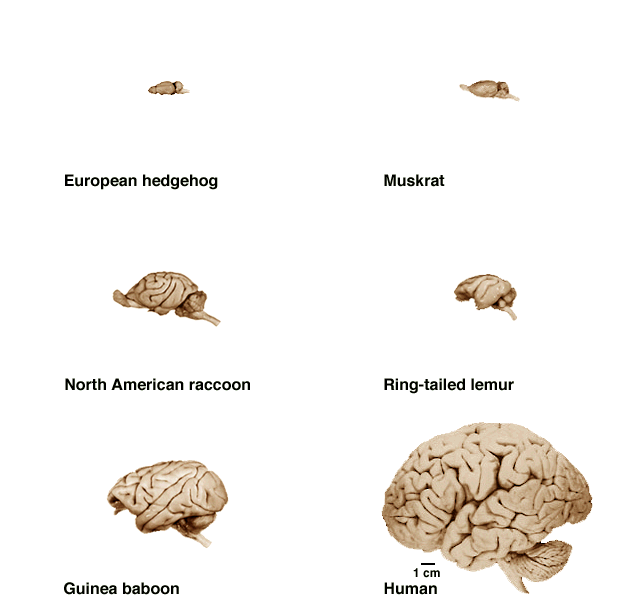
Weighing only about three pounds when fully grown, your brain stores your every memory, generates your every thought and feeling and allows you to manage your world. More than any other part of the body, the human brain—and its capacity for symbolic thought—sets us apart from all other species.
Although the human brain reached its current size some 150,000 years ago, the first evidence of symbolic thought didn't appear until tens of thousands of years later. Our symbolic awakening occurred when modern humans began to use their brains differently (read more).

Tuesday, 2 January 2007

Cave Painting 15,000-10,000 BC

Wounded bison attacking a man. c. 15,000-10,000 BC. Bison length 43 in. (110 cm) Lascaux, France

Tuesday, 19 December 2006

Search For Your Ancestors

Would you like to know about your ancestors? Just search in the largest collection of free family history, family tree and genealogy records in the world (Search).

Saturday, 16 December 2006

Brain evolution

Evidence of brain evolution can be seen in various fields of biology, such as paleontology, ethology, behavioral biology, cognitive psychology, molecular biology and genetics.
Please, compare to brain development.

Wednesday, 13 December 2006

Evolution can't explain the soul

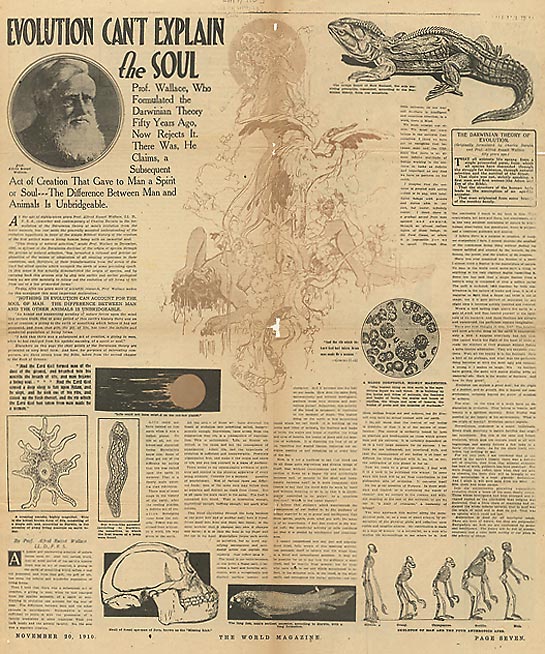
This large, double-page article is full of sensational quotes designed to engage readers. The article is from The World Magazine, 19 November 1910 (page 7). The headline reads: 'Prof. Wallace, Who Formulated the Darwinian theory fifty years ago, now rejects it. There was, he claims, a subsequent act of creation that gave to man a spirit or soul... ...the difference between man and animals is unbridgeable.' This is extremely interesting as Wallace strongly defended 'Darwinian evolution' but increasingly, due to his spiritualist beliefs, felt he could not relate natural selection to human evolution. The article is richly illustrated with Wallace's portrait, and a biblical scene depicting Adam and Eve.


Sunday, 10 December 2006

How did humans start talking?

Scientists disagree over how human language arose. Some think that our human ancestors started talking as soon as their brains became large and sophisticated enough. Others think that language evolved slowly, from the gestures and sounds used by our earlier ape-like ancestors. To test whether present-day apes have the ability to communicate using language, researchers have tried teaching them different kinds of language.