Showing posts with label (Level 4). Show all posts

Tuesday, 8 November 2011

Brain Workshop

What if a simple mental exercise could improve your memory and intelligence?
Brain Workshop screenshot
A recent study published in PNAS, an important scientific journal, shows that a memory task called dual n-back improves working memory (short term memory) andfluid intelligence. These findings are important because fluid intelligence was previously thought to be unchangeable.
Those findings have since been replicated twice with strongly positive results, and two more times in smaller studies with weaker, but still positive, results.
Brain Workshop implements this dual n-back task, and enables you to improve your working memory and fluid intelligence. The dual n-back task involves remembering a sequence of spoken letters and a sequence of positions of a square at the same time, and identifying when a letter or position matches the one that appeared n trials earlier. Brain Workshop can closely replicate the conditions of the original study. In addition, it also includes optional extended game modes such as Triple N-Back andArithmetic N-Back. It also includes features such as statistics tracking, graphs and easy configurability.
Anecdotal evidence suggests that the dual n-back task also enhances focus and attention and may help improve the symptoms of ADHD/ADD.
Brain Workshop works on Windows XP, Windows Vista, Mac OS X and Linux.
Since its initial release in August 2008, Brain Workshop has been downloaded over 384,000 times!
New to the Dual N-Back phenomenon?
We welcome the use of Brain Workshop for experimental research. Please contact us to discuss this possibility.

Tuesday, 15 September 2009

The shape of the book

It is impossible to establish exactly when the book was invented or first began to circulate. Indeed, none of the forms exhibited here can be considered the embryo of what we have come to refer to as books. Nevertheless, if we narrow our scope to the Laurentian manuscript collection—in itself quite extensive—it would appear that the potsherd on which, probably under dictation, a pupil from the 2nd century BC wrote the ancient verses of one of Sappho’s odes marks the most significant threshold of its history; the fragment represents the longest extant portion of the poem, which may have been dedicated to Aphrodite. The ostracon is a rare medium due solely to the fact that, since it is a fragile material that was not used for anything meant to endure, large quantities have not been handed down to us. The book form we chose as our endpoint—and thus closer to our own era—is a 19th-century Japanese erotic-grotesque scroll expressing a genre that enjoyed widespread and lasting circulation because of its caricatural and entertaining contents. Due to its distant provenance, however, it is a rarity in Italian libraries. Between these two intentionally striking extremes, we have created an itinerary that requires some explanation.

Tuesday, 1 July 2008

Sleep paralysis

Sleep paralysis is a condition characterized by temporary paralysis of the body shortly after waking up (known as hypnopompic paralysis) or, less often, shortly before falling asleep (known as hypnagogic paralysis).[1] Physiologically, it is closely related to the paralysis that occurs as a natural part of REM (rapid eye movement) sleep, which is known as REM atonia. Sleep paralysis occurs when the brain awakes from a REM state, but the bodily paralysis persists. This leaves the person fully aware, but unable to move. In addition, the state may be accompanied by hypnagogic hallucinations. More often than not, sleep paralysis is believed by the person affected by it to be no more than a dream. This explains many dream recountings which describe the person lying frozen and unable to move. The hallucinatory element to sleep paralysis makes it even more likely that someone will interpret the experience as a dream, since completely fanciful, or dream-like, objects may appear in the room alongside one's normal vision.
Possible causesSleep paralysis occurs during REM sleep, thus preventing the body from manifesting movements made in the subject's dreams. Very little is known about the physiology of sleep paralysis. However, some have suggested that it may be linked to post-synaptic inhibition of motor neurons in the pons region of the brain. In particular, low levels of melatonin may stop the depolarization current in the nerves, which prevents the stimulation of the muscles, to prevent the body from enacting the dreamt activity (e.g. preventing a sleeper from flailing his legs when dreaming about running). Many people who commonly enter sleep paralysis also suffer from narcolepsy. Especially in African-Americans panic disorder often co-occurs with sleep paralysis[2]. However, various studies suggest that many or most people will experience sleep paralysis at least once or twice in their lives. Some reports read that various factors increase the likelihood of both paralysis and hallucinations. These include: [3]
Sleeping in an upwards supine position
Irregular sleeping schedules; naps, sleeping in, sleep deprivation
Increased stress
Sudden environmental/lifestyle changes
A lucid dream that immediately precedes the episode. Also conscious induction of sleep paralysis is a common technique to enter a state of lucid dreams, also known as WILD .
Artificial sleeping aids, ADD medications and/or antihistamines
Recent use of hallucinogenic drugs
TreatmentDuring paralysis episodes, patients may be advised to try moving the facial muscles and moving eyes from one side to the other. This may hasten the termination of the attack. Clonazepam is highly effective in the treatment of sleep paralysis.[4] The initial dose is 0.5 mg at bedtime, while an increase to 1 mg per night might be necessary to maintain potency. Anecdotal reports indicate SSRIs such as fluoxetine markedly decrease the incidence of sleep paralysis. Several people who have been both on and off SSRIs have reported corresponding decreases and increases in sleep paralysis episodes. Others report no effects at all.
Cultural referencesComplete references to many cultures are given in the References section
In Vietnamese, sleep paralysis is referred to as "ma de", meaning "held down by a ghost". Most people in this culture believe that a ghost has entered your body, causing the paralysis state.
In Japanese, sleep paralysis is referred to as kanashibari (, literally "bound or fastened in metal," from kane "metal" and shibaru "to bind, to tie, to fasten"). This term is occasionally used by English speaking authors to refer to the phenomenon both in academic papers and in pop psych literature.
In Hungarian folk culture sleep paralysis is called "lidércnyomás" ("lidérc pressing") and can be attributed to a number of supernatural entities like "lidérc", "boszorkány" (witch), "tündér" (fairy) or "ördögszerető".[5] The word "boszorkány" itself stems from the Turkish root "bas-", meaning "to press".[6]
Kurdish people call this phenomenon a "mottaka", they believe that some one, in a form of a ghost or perhaps an evil spirit, turns up on top the of the person in the middle of the night and suffocates him/her. Apparently this happens usually when some one has done something bad.
In New Guinea, people refer to this phenomenon as "Suk Ninmyo", believed to originate from sacred trees that use human essence to sustain its life. The trees are said to feed on human essence during night as to not disturb the human's daily life, but sometimes people wake unnaturally during the feeding, resulting in the paralysis.
In Turkey this is called "karabasan" ("black-pressing"). It is believed that it is a creature which attacks people in their sleep.
In Mexico, it's believed that sleep paralysis is in fact the spirit of a dead person getting on the person and impeding movement, calling this "se me subió el muerto" (the dead person got on me).
Ogun Oru is a traditional explanation for nocturnal disturbances among the Yoruba of Southwest Nigeria; ogun oru (nocturnal warefare) involves an acute night-time disturbance that is culturally attributed to demonic infiltration of the body and psyche during dreaming. Ogun oru is characterized by its occurrence, a female preponderance, the perception of an underlying feud between the sufferer's earthly spouse and a ;spiritual' spouse, and the event of bewitchment through eating while dreaming. The condition is believed to be treatable through Christian prayers or elaborate traditional rituals designed to exorcise the imbibed demonic elements. [7]
Several studies have shown that African-Americans may be predisposed to isolated sleep paralysis also known as "the witch is riding you," or "the haint is riding you." [8] In addition, other studies have shown that African-Americans who have frequent episodes of isolated sleep paralysis, i.e., reporting having one or more sleep paralysis episodes per month coined as "sleep paralysis disorder," were predisposed to having panic attacks. [9] This finding has been replicated by other independent researchers [10] [11]
Sleep paralysis in literature, art and music
(1605) Miguel de Cervantes makes mention of the phenomenon in Don Quixote when a tavern wench jumps into the bed of the soundly sleeping Sancho Panza, who, started, and feeling a prodigious weight upon him, thought he was labouring under the nightmare.
(1851) There is a particularly fascinating account of sleep paralysis in Herman Melville's novel Moby-Dick. Chapter 4 (The Counterpane) is an account of Ishmael's meditation on an episode of sleep paralysis in the middle of which he could not distinguish the difference between Queequeg's arm and the quilt. Indeed, he could not even distinguish the difference between his own body and his surroundings. He then recalls an earlier episode of sleep paralysis from his childhood, which he determines was the precise moment he discovered the feeling of "otherness" of his own body with respect to his surroundings.
(1936) An account can also be found in Ernest Hemingway's The Snows of Kilimanjaro, in which death approaches and sits upon the narrator's chest so that he cannot breathe.
(1969) The main character in Kingsley Amis' novel The Green Man also suffers from the affliction.
(1975) Maxine Hong Kingston recounts an episode in her book The Woman Warrior where her mother, Brave Orchid, suffers a night of sleep paralysis in the "Haunted Room", in which she claims she battles a "Sitting Ghost".
In Zimbabwean Shona culture the word Madzikirira is used referring to the fact that something will really be pressing you down and mostly they refer to the spiritual world where some other spirit especially evil one will be trying to use you. The people believe that witches can only be people of close relations to be effective and hence a witch can try to use your spirit to bewitch your relatives.
(2001) The progressive rock band Dredg explores the different aspects of sleep paralysis, on their album El Cielo. The booklet with El Cielo contains letters written by sufferers of sleeping disorders with descriptions of various experiences with or relating to sleep paralysis. Singer Gavin Hayes incorporates and expands upon the material found in the booklet for the lyrics to the album; all of the songs on the album (except the instrumentals) contain snippets of the text in the booklet.
(2006) Experimental band Fear Before the March of Flames talk about the struggles of dealing with constant sleep paralysis on their album "The Always Open Mouth". One of the songs is even called "Drowning the Old Hag".
Notes
1. ^ When considered a disease, isolated sleep paralysis is classified as: Diseases Database 12182, MeSH D0201882. ^ Friedman, S. & Paradis, C. (2002). Panic disorder in African-Americans: Symptomatology and isolated sleep paralysis. Culture, Medicine and Psychiatry, 26,179-198.3. ^ J. A. Cheyne. Preventing and Coping with Sleep Paralysis. Retrieved on 17 July, 2006.4. ^ Wills L, Garcia J. (2002) Parasomnias: epidemiology and management16(12):803-10.5. ^ lidérc, Magyar Néprajzi Lexikon, Akadémiai Kiadó, Budapest 1977, ISBN6. ^ boszorkány, Magyar Néprajzi Lexikon, Akadémiai Kiadó, Budapest 1977, ISBN7. ^ Aina OF, Famuyiwa OO (2007). "Ogun Oru: a traditional explanation for nocturnal neuropsychiatric disturbances among the Yoruba of Southwest Nigeria". Transcultural psychiatry 44 (1): 44-54. DOI:10.1177/1363461507074968. PMID 17379609. 8. ^ Bell CC, Shakoor B, Thompson B, Dew D, Hughley E, Mays R, Shorter-Gooden K (1984). "Prevalence of isolated sleep paralysis in black subjects". Journal of the National Medical Association 76 (5): 501-508. PMID 6737506. 9. ^ Bell CC, Dixie-Bell DD, Thompson B (1986). "Further studies on the prevalence of isolated sleep paralysis in black subjects". Journal of the National Medical Association 78 (7): 649-659. PMID 3746934. 10. ^ Paradis CM, Friedman S (2006). "Sleep Paralysis in African Americans with Panic Disorder". Transcultural psychiatry 43 (4): 692-694. PMID 15881272. 11. ^ Friedman S, Paradis CM, Hatch M (1994). "Characteristics of African-Americans and white patients with panic disorder and agoraphobia". Hospital and Community Psychiatry 45 (8): 798-803. PMID 7982696.
References
Bower, Bruce (July 9, 2005). "Night of the Crusher." Science News.
Conesa, J. (2000). Geomagnetic, cross-cultural and occupational faces of sleep paralysis: An ecological perspective. Sleep and Hypnosis, 2, (3), 105-111.
Conesa, J. (2002). Isolated Sleep Paralysis and Lucid Dreaming: Ten-year longitudinal case study and related dream frequencies, types, and categories. Sleep and Hypnosis, 4, (4), 132-143.
Conesa, J. (2003). Sleep Paralysis Signaling (SPS) As A Natural Cueing Method for the Generation and Maintenance of Lucid Dreaming. Presented at The 83rd Annual Convention of the Western Psychological Association, May 1 - 4, 2003 in Vancouver, BC, Canada.
Conesa-Sevilla, Jorge (2004). Wrestling With Ghosts: A Personal and Scientific Account of Sleep Paralysis. Pennsylvania: Xlibris/Randomhouse.
Firestone K. The “Old Hag”: sleep paralysis in Newfoundland. The Journal of Psychoanalytic Anthropology 1985; 8:47-66.
Fukuda K, Miyasita A, Inugami M, Ishihara K. High prevalence of isolated sleep paralysis: kanashibari phenomenon in Japan. Sleep 1987; 10:279-286.
Hartmann E. The nightmare: the psychology and biology of terrifying dreams. New York:Basic,1984.
Hufford D.J. The terror that comes in the night: an experience-centered study of supernatural assault traditions. Philadelphia:University of Pennsylvania Press, 1982
Kettlewell, N; Lipscomb, S; Evans, E. (June, 1993). "Differences in neuropsychological correlates between normals and those experiencing "Old Hag Attacks'." Perceptual and Motor Skills. 76 (3 Pt 1): 839-45; discussion 846. PMID 8321596
Ness RC. “The Old Hag” phenomenon as sleep paralysis: a bicultural interpretation . Culture, Medicine and Psychiatry 1978; 2:15-39.
Ohayon MM, Zulley J, Guilleminault C, Smirne, S. Prevalence and pathologic associations of sleep paralysis in the general population. Neurology, 1999; 52:1194-1200.
Sagan, Carl (1997). The Demon-Haunted World: Science as a Candle in the Dark.
Schneck JM. Sleep paralysis and microsomatognosia with special reference to hypnotherapy . The International Journal of Clinical and Experimental Hypnosis 1977; XXV:72-77.
Takeuchi T, Miyasita A, Sasaki Y, Inugami M, Fukuda K. Isolated sleep paralysis elicited by sleep interruption. American Sleep Disorders Association and Sleep Research Society, 1992; 15: 217-225.

Monday, 19 November 2007

Flying Snake

The image of airborne snakes may seem like the stuff of nightmares (or a certain Hollywood movie), but in the jungles of South and Southeast Asia it is reality.Flying snake is a misnomer, since, barring a strong updraft, these animals can’t actually gain altitude. They’re gliders, using the speed of free fall and contortions of their bodies to catch the air and generate lift.Once thought to be more parachuters than gliders, recent scientific studies have revealed intricate details about how these limbless, tube-shaped creatures turn plummeting into piloting. To prepare for take-off, a flying snake will slither to the end of a branch, and dangle in a J shape. It propels itself from the branch with the lower half of its body, forms quickly into an S, and flattens to about twice its normal width, giving its normally round body a concave C shape which can trap air. By undulating back and forth, the snake can actually make turns. Flying snakes are technically better gliders than their more popular mammalian equivalents, the flying squirrels.There are five recognized species of flying snake, found from western India to the Indonesian archipelago. Knowledge of their behavior in the wild is limited, but they are thought to be highly arboreal, rarely descending from the canopy. The smallest species reach about 2 feet (61 centimeters) in length and the largest grow to 4 feet (1.2 meters).Their diets are variable depending on their range, but they are known to eat rodents, lizards, frogs, birds, and bats. They are mildly venomous snakes, but their tiny, fixed rear fangs make them harmless to humans.Scientists don’t know how often or exactly why flying snakes fly, but it’s likely they use their aerobatics to escape predators, to move from tree to tree without having to descend to the forest floor, and possibly even to hunt prey.One species, the twin-barred tree snake, is thought to be rare in its range, but flying snakes are otherwise quite abundant and have no special conservation status.

Friday, 24 August 2007

Hall of Human Origins

All species consist of individuals that differ at some level. In Homo sapiens, population diversity arose as small groups occupied varied environments around the world. Localized populations changed due to genetic drift and natural selection. For example, some populations eventually showed more susceptibility to certain diseases, or more ability to digest certain foods. Superficial differences in stature and hair, eye, and skin color also arose among individuals and populations.Although these population changes take place at a genetic level, it does not mean that genes define "race." Race is cultural and social, not biological.Small, isolated groups are less and less prevalent in the human population. Our population is now abundant, consisting of larger, varied groups that intermingle and overlap. Since humans reproduce both within and between groups, we constantly mix genetic information. As a result, genetic differences between people of the same "racial" group can be greater than the those between people of two different groups. Furthermore, influences other than genes—such as hormones and environmental factors—also contribute to individual variation (go).

Wednesday, 11 July 2007

Thursday, 5 April 2007

Worldmapper

Worldmapper is a collection of world maps, where territories are re-sized on each map according to the subject of interest.
There are 366 maps, also available as PDF posters.

Friday, 23 March 2007

Timeline of art history

The Metropolitan Museum of Art (NY) presents an illustrative timeline of art history (view).

Wednesday, 3 January 2007

Hurricane Katrina simulation


Click on image to view movie.

Orange represents ocean temperatures at 82 degrees Fahrenheit or higher. This is the temperature required for hurricanes to form. The bottom left window shows wind analysis model data from NASA's Modeling, Analysis, and Prediction (MAP '05) program. The top right window shows rainfall accumulation for Hurricane Katrina from the TRMM spacecraft. The bottom right window shows energy-releasing deep convective clouds (as high as 16 km) in the eyewall of Hurricane Katrina. These clouds, called hot towers, formed on August 28 while the storm was intensifying to a category 5 hurricane.

Planets and stars size in scale

Tuesday, 2 January 2007

Cave Painting 15,000-10,000 BC

Wounded bison attacking a man. c. 15,000-10,000 BC. Bison length 43 in. (110 cm) Lascaux, France

Saturday, 30 December 2006

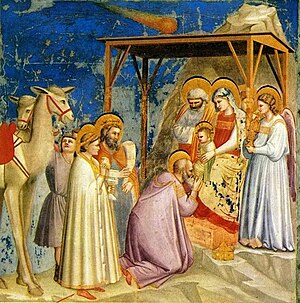
Giotto and the comet

Giotto di Bondone (Colle di Vespignano, near Florence 1267 January 8 - Florence 1337), better known simply as Giotto, was a Florentine painter and architect who is generally considered the first in a line of great artists who contributed to and developed the Italian Renaissance. Giotto's master work is the Arena Chapel cycle of the Cappella degli Scrovegni in Padua depicting the life of the Virgin and the passion of Christ completed around 1305. The scheme has 100 major scenes with the heavily sculptural figures set in compressed but naturalistic settings often using forced perspective devices. Famous panels in the series include the Adoration of the Magi (picture), in which a comet like Star of Bethlehem streaks across the sky and the Flight from Egypt in which Giotto broke many traditions for the depiction of the scene.
This fresco, painted sometime between 1304 and 1306, features an accurately represents a comet above the Nativity stable. The fresco's realistic potrayal strongly suggests that it was based on the artist's first-hand observation of the comet Halley during its appearance in the skies over Europe in Oct. 1301. Almost seven centuries later the spaceprobe "Giotto" from the European Space Agency, was designed to study Halley's Comet. On March, 13, 1986, Giotto approached at a 596 kilometer distance from Halley's nucleus and obtained our first direct images of a comet nucleus. Giotto's images showed the nucleus to be an irregular object, something like a potato, with dimensions 15 km long and up to 10 km wide (picture).


Monday, 25 December 2006

A pale blue dot

It was Carl Sagan's idea to turn Voyager's camera back toward the planet that launched the spacecraft in order to reveal to that planet's inhabitants their "true circumstance and condition". After much resistance, Dr. Sagan prevailed, and on February 14, 1990, from a distance of 6.4 billion kilometers , Voyager 1 captured this image of our Earth. Here the entire world fills only 0.12 pixel and appears as a tiny crescent of light.


Look again at that dot. That's here. That's home. That's us. On it everyone you love, everyone you know, everyone you ever heard of, every human being who ever was, lived out their lives. The aggregate or your joy and suffering, thousands of confident religions, ideologies and economic doctrines, every hunter and forager, every hero and coward, every creator and distroyer of civilization, every king and peasant, every young couple in love, every mother and father, hopeful child, inventor and explorer, every teacher of morals, every corrupt politician, every "superstar", every "supreme leader", every saint and sinner, in the history of our species lived here -on a mote of dust suspended in a sunbeam.

The earth is a very small stage in a vast cosmic arena. Think of the rivers of blood spilled by all those generals and emperors so that, in glory and triumph, they could become the momentary masters of a fraction of a dot. Think of the endless cruelties visited by the inhabitants of a corner of this pixel on the scarcely distinguishable inhabitants of some other corner, how frequent their misunderstandings, how eager they are to kill one another, how fervent their hatreds.

Our posturing, our imagined self-importance, the delusion that we have some privileged position in the Universe, are challenged by this point of pale light. Our planet is a lonely speck in the great enveloping cosmic dark. In our obscurity, in all this vastness, there is no hint that help will come from elsewhere to save us from ourselves.

The Earth is the only world known so far to harbor life. There is nowhere else, at least in the near future, to which our species could migrate. Visit, yes. Settle, not yet. Like it or not, for the moment the Earth is where we make our stand.

It has been said that astronomy is a humbling and character-building experience. There is perhaps no better demonstration of the folly of human conceits that this distant image or our tiny world. To me, it underscores our responsability to deal more kindly with one another , and to preserve and cherish the pale blue dot , the only home we've ever known.

Carl Sagan, Pale Blue Dot, Random House, 1994

Statue of Amun with features of Tutankhamun

Amun typically appears as a man wearing a tall, double-plumed headdress. His tall headdress is missing from this statue, but his crown bears traces of gilding. Amun wears the false beard of a deity, an elaborately beaded broad collar, and a short kilt decorated on the belt with a tyet-amulet, a symbol related both to the goddess Isis and to the ankh, the hieroglyph meaning “life”. The god also holds ankhs indicating his immortality. His hands, which have been intentionally cut back, may represent a deliberate alteration to allow the statue to fit into a shrine or a portable ceremonial boat used to carry it in processions.
Provenance unknown, possibly Thebes, late Dynasty 18-early Dynasty 19 (1332-1292 BCE), greywacke.

Saturday, 23 December 2006

Hubble Reopens Eye on the Universe

In its first glimpse of the heavens following the successful December 1999 servicing mission, NASA's Hubble Space Telescope captured a majestic view of a planetary nebula, the glowing remains of a dying, Sun-like star. This stellar relic, first spied by William Herschel in 1787, is nicknamed the "Eskimo" Nebula (NGC 2392) because, when viewed through ground-based telescopes, it resembles a face surrounded by a fur parka. In this Hubble telescope image, the "parka" is really a disk of material embellished with a ring of comet-shaped objects, with their tails streaming away from the central, dying star. The Eskimo's "face" also contains some fascinating details. Although this bright central region resembles a ball of twine, it is, in reality, a bubble of material being blown into space by the central star's intense "wind" of high-speed material. In this photo, one bubble lies in front of the other, obscuring part of the second lobe. Scientists believe that a ring of dense material around the star's equator, ejected during its red giant phase, created the nebula's shape. The bubbles are not smooth like balloons but have filaments of denser matter. Each bubble is about 1 light-year long and about half a light-year wide. Scientists are still puzzled about the origin of the comet-shaped features in the "parka." One possible explanation is that these objects formed from a collision of slow-and fast-moving gases. The Eskimo Nebula is about 5,000 light-years from Earth in the constellation Gemini. The picture was taken Jan. 10 and 11, 2000, with the Wide Field and Planetary Camera 2. The nebula's glowing gases produce the colors in this image: nitrogen (red), hydrogen (green), oxygen (blue), and helium (violet).

World Wind

World Wind lets you zoom from satellite altitude into any place on Earth. Leveraging Landsat satellite imagery and Shuttle Radar Topography Mission data, World Wind lets you experience Earth terrain in visually rich 3D, just as if you were really there.Virtually visit any place in the world. Look across the Andes, into the Grand Canyon, over the Alps, or along the African Sahara (download).

Tuesday, 19 December 2006

Search For Your Ancestors

Would you like to know about your ancestors? Just search in the largest collection of free family history, family tree and genealogy records in the world (Search).

Wednesday, 13 December 2006

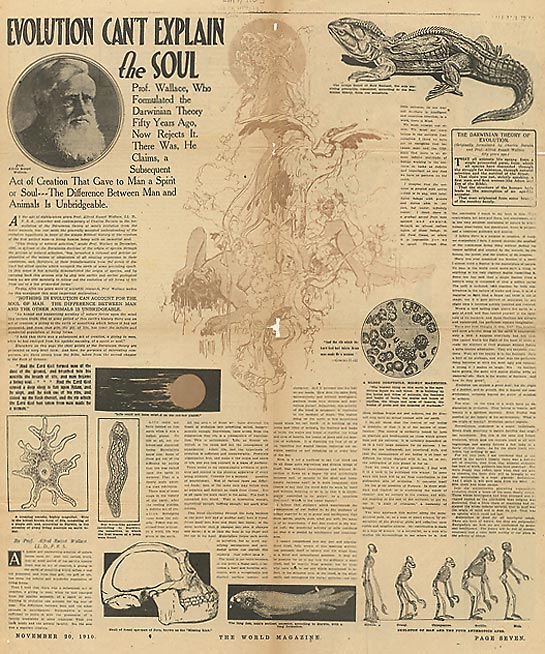
Evolution can't explain the soul

This large, double-page article is full of sensational quotes designed to engage readers. The article is from The World Magazine, 19 November 1910 (page 7). The headline reads: 'Prof. Wallace, Who Formulated the Darwinian theory fifty years ago, now rejects it. There was, he claims, a subsequent act of creation that gave to man a spirit or soul... ...the difference between man and animals is unbridgeable.' This is extremely interesting as Wallace strongly defended 'Darwinian evolution' but increasingly, due to his spiritualist beliefs, felt he could not relate natural selection to human evolution. The article is richly illustrated with Wallace's portrait, and a biblical scene depicting Adam and Eve.