Showing posts with label Art. Show all posts

Tuesday, 1 February 2011

Google Art Project

Art Project, powered by Google

Explore museums from around the world, discover and view hundreds of artworks at incredible zoom levels, and even create and share your own collection of masterpieces (Go).
What is the ‘Art Project’?
A unique collaboration with some of the world’s most acclaimed art museums to enable people to discover and view more than a thousand artworks online in extraordinary detail.
  • Explore museums with Street View technology: virtually move around the museum’s galleries, selecting works of art that interest you, navigate though interactive floor plans and learn more about the museum and you explore.
  • Artwork View: discover featured artworks at high resolution and use the custom viewer to zoom into paintings. Expanding the info panel allows you to read more about an artwork, find more works by that artist and watch related YouTube videos.
  • Create your own collection: the ‘Create an Artwork Collection’ feature allows you to save specific views of any of the 1000+ artworks and build your own personalised collection. Comments can be added to each painting and the whole collection can then be shared with friends and family.

Wednesday, 24 September 2008

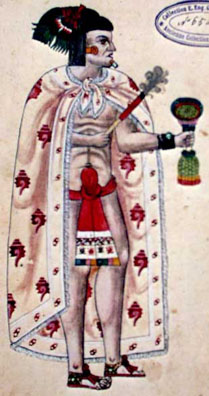
Codex Ixtlilxochitl

This is a manuscript with illustrations on European paper in folio, text in the Spanish language and is a fragment of a codex attributed by Leon y Parma to Don Fernando de Alva Ixtlilxochitl who was a "nobleman" of the Confederation of Culhua Mexica ("Aztec Empire") and the outstanding native historian of the early years of the Spanish Conquest. The codex deals with people and events of the pre-Conquest "Aztec Empire", which Ixtlilxochitl remembered. This will, naturally, be indispensible for any complete Latin American Library.

Saturday, 29 December 2007

Koopman Collection

The Koopman Collection in the Koninklijke Bibliotheek, National Library of the Netherlands consists of over 8250 French works of literature in rare and deluxe editions, including dedication copies and artists' books, a series of manuscripts and archival documents. The The books are all listed in the KB online public catalogue and are available for reference in the Special Collections reading room. A provisional catalogue also exists in book form.
first donation for the collection dates from 1934. The collection was donated by Louis Koopman (1887-1968), in commemoration of his fiancée Anny Antoine (1897-1933) who died in an accident. Thanks to a legacy, the Anny Antoine/Louis Koopman Foundation, the collection can still be expanded with new acquisitions on a daily basis.
Léger, Matisse, Picasso, Braque, Colette, Cocteau, De Beauvoir, Duras, and many others… The Koopman Collection is a unique collection of French literary works of the 20th century in special editions.
A wide selection of artists' books, dedication copies and deluxe editions is highlighted in seven films on this webexhibition and in dozens of richly illustrated essays on books from the collection.
Link to the digital collection and to the web exhibition.

Wednesday, 11 July 2007

Friday, 27 April 2007

Photographs from The Met

See one hundred of the best photograph collection works of art from The Metropolitan Museum online.


Charles Nègre (French, 1820–1880). The Refectory of the Imperial Asylum at Vincennes, 1858–59
Gathered in the light-drenched refectory of a newly constructed convalescent hospital on the outskirts of Paris, patients and staff alike turned their eyes and attention to the man with the enormous camera at one end of the room, Charles Nègre. The resulting image, here in a rare unmounted and unretouched proof print from the artist's studio, is the largest and most engaging in a series of photographs that Nègre was commissioned to make as documentation and celebration of the Imperial Asylum at Vincennes. The hospital was established by Emperor Napoléon III to provide those injured on the construction site or in the factory—"the worker's true field of honor," in the words of one of Napoléon's ministers—with care comparable to that given to the nation's military veterans.
Trained as a painter in the same studio as Roger Fenton and Gustave Le Gray, Nègre was one of the era's most skilled photographers of architecture, possessing a particular sensitivity to the ways in which light and shadow animate the surfaces of centuries-old monuments. Here, he seized upon the streaming sunlight as a vehicle to enliven the structure and texture of his picture and to suggest enhanced activity and health in the hospital inhabitants.

Friday, 23 March 2007

Summer Mountains from China

This pictures let us travel to China, during the Song dynasty—one of the golden ages of this ancient civilization. Here we see one of the finest paintings in the Metropolitan's collection, Summer Mountains, which was painted in the mid-eleventh century and was once the treasured possession of several Chinese emperors.We know, from writings of the period that we are meant to enter with our imaginations into this world created solely of ink and pale pigments on silk.(view video with explanations)

Summer Mountains, Northern Song dynasty (960–1127), 11th centuryAttributed to Qu Ding (Chinese, active ca. 1023–ca. 1056), China

Video of Statue of a Kouros

This Kouros, a work of great nobility, probably stood on a tomb, although its stance and expression are shared by cult statues of gods which suggests that it may have been created for a sanctuary. (view video with explanations)


Statue of a kouros (youth), ca. 590–580 B.C.; ArchaicGreek, AtticNaxian marble; H. without plinth 76 in. (193 cm)Fletcher Fund, 1932 (32.11.1)

Timeline of art history

The Metropolitan Museum of Art (NY) presents an illustrative timeline of art history (view).

Sunday, 14 January 2007

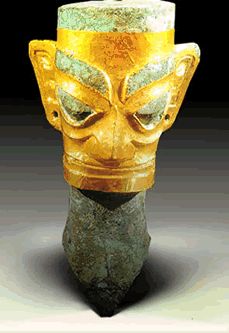
Historical Wonders of Sanxingdui

The site of Sanxingdui, located in the city of Guanghan, 40 km from Chengdu, Sichuan Province (China), is recognized as one of the most important ancient remains in the world for its vast size, lengthy period and enriched cultural contents.
The first Sanxingdui relics were discovered by a farmer in 1929 and excavation has continued ever since. During this period, generations of archaeologists have worked on the discovery and research of the Sanxingdui culture. In 1986, two major sacrificial pits were found and they aroused widespread academic attention around the world.
The Sanxingdui finds are exciting, but they remain enigmatic. No texts have been found, nor is there any mention of this culture in the records of other countries. Analysis of lead and other elements in the bronzes indicates sources similar to those of other cultures along the lower reaches of the Yangtze River. At this point, however, the unique culture that produced these artifacts remains a mystery (View Pictures).

Tuesday, 2 January 2007

Cave Painting 15,000-10,000 BC

Wounded bison attacking a man. c. 15,000-10,000 BC. Bison length 43 in. (110 cm) Lascaux, France

The Christ of Dalí

Christ of Saint John of the Cross, 1951

Between Text and Image in Kandinsky’s Oeuvre

Wassily Kandinsky‘Klänge’ from the album Klänge, Munich c.1912.

In 1938 Wassily Kandinsky published the text ‘My Woodcuts’ in the French periodical XXe Siècle. As was so often the case, when he wrote about his prints he focused largely on general artistic principles: the majority of the text is devoted to a general discussion of the need to privilege ‘synthesis’ over ‘analysis’ in both art and in life. However, he specifically referred to the album of poetry and engravings Sounds (Klänge), which had been published in Munich c.1912, as ‘a small example of synthetic work’

Cossacks 1910-11

Wassily Kandinsky. Cossacks 1910-11. Tate Gallery.

The mysterious Cycladic civilization

The Cup-Bearer, a Cycladic figurine of unknown provenance dating between 2800-2200 B.C.. A new discovery of smashed marble figurines on an uninhabited Aegean Sea islet has shed new light on the mysterious Cycladic civilization, whose strikingly modern figurines are prized exhibits in museums and collections worldwide.

Saturday, 30 December 2006

Giotto and the comet

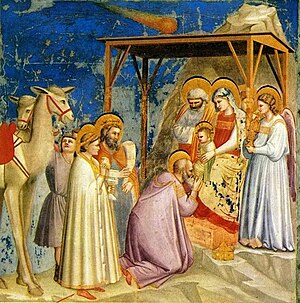
Giotto di Bondone (Colle di Vespignano, near Florence 1267 January 8 - Florence 1337), better known simply as Giotto, was a Florentine painter and architect who is generally considered the first in a line of great artists who contributed to and developed the Italian Renaissance. Giotto's master work is the Arena Chapel cycle of the Cappella degli Scrovegni in Padua depicting the life of the Virgin and the passion of Christ completed around 1305. The scheme has 100 major scenes with the heavily sculptural figures set in compressed but naturalistic settings often using forced perspective devices. Famous panels in the series include the Adoration of the Magi (picture), in which a comet like Star of Bethlehem streaks across the sky and the Flight from Egypt in which Giotto broke many traditions for the depiction of the scene.
This fresco, painted sometime between 1304 and 1306, features an accurately represents a comet above the Nativity stable. The fresco's realistic potrayal strongly suggests that it was based on the artist's first-hand observation of the comet Halley during its appearance in the skies over Europe in Oct. 1301. Almost seven centuries later the spaceprobe "Giotto" from the European Space Agency, was designed to study Halley's Comet. On March, 13, 1986, Giotto approached at a 596 kilometer distance from Halley's nucleus and obtained our first direct images of a comet nucleus. Giotto's images showed the nucleus to be an irregular object, something like a potato, with dimensions 15 km long and up to 10 km wide (picture).


Monday, 25 December 2006

Statue of Amun with features of Tutankhamun

Amun typically appears as a man wearing a tall, double-plumed headdress. His tall headdress is missing from this statue, but his crown bears traces of gilding. Amun wears the false beard of a deity, an elaborately beaded broad collar, and a short kilt decorated on the belt with a tyet-amulet, a symbol related both to the goddess Isis and to the ankh, the hieroglyph meaning “life”. The god also holds ankhs indicating his immortality. His hands, which have been intentionally cut back, may represent a deliberate alteration to allow the statue to fit into a shrine or a portable ceremonial boat used to carry it in processions.
Provenance unknown, possibly Thebes, late Dynasty 18-early Dynasty 19 (1332-1292 BCE), greywacke.