Wednesday, 27 March 2013

Tuesday, 13 May 2008
Sunday, 16 September 2007


Wednesday, 15 August 2007
Averroes' commentary on De Anima
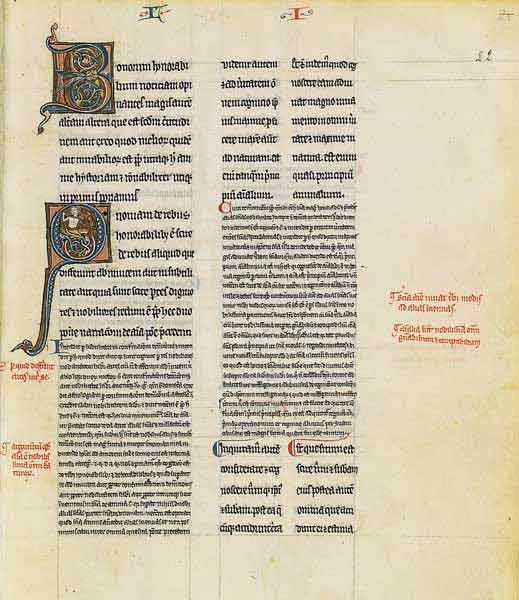
On the Soul (Greek Περὶ Ψυχῆς (Perì Psūchês), Latin De Anima) is a major treatise by Aristotle, outlining his philosophical views on the nature of living things. His discussion centres on the kinds of souls possessed by different kinds of living things, distinguished by the different life-processes those organisms go through. Thus plants have the capacity for nourishment and reproduction, the minimum that must be possessed by any kind of living organism. Lower animals have, in addition, the powers of sense-perception and self-motion (action). Humans have all these as well as intellect.
The notion of soul used by Aristotle is only distantly related to the usual modern conception. He holds that the soul is the form, or essence of any living thing; that it is not a distinct substance from the body that it is in; that it is the possession of soul (of a specific kind) that makes an organism an organism at all, and thus that the notion of a body without a soul, or of a soul in the wrong kind of body, is simply unintelligible. (He speculates that some parts of the soul--the intellect--may be conceived to exist without the body, but most cannot.) It is difficult to reconcile these points with the popular picture of a soul as a sort of spiritual substance "inhabiting" a body. Some commentators have suggested that Aristotle's term soul is better translated as lifeforce.
Averroes (Ibn Rushd) (1126-1198) was an Andalusian-Arab philosopher and physician. He wrote commentaries on most of the surviving works of Aristotle. These were not based on primary sources (it is not known whether he knew Greek), but rather on Arabic translations. On each work, he wrote the Jami, the Talkhis and the Tafsir which are, respectively, a simplified overview, an intermediate commentary with more critical material, and an advanced study of Aristotelian thought in a Muslim context. The terms are taken from the names of different types of commentary on the Qur'an.
Sunday, 21 January 2007

Saturday, 23 December 2006
The Brain in a Vat
 The Brain in a Vat thought-experiment is most commonly used to illustrate global or Cartesian skepticism. You are told to imagine the possibility that at this very moment you are actually a brain hooked up to a sophisticated computer program that can perfectly simulate experiences of the outside world. Here is the skeptical argument. If you cannot now be sure that you are not a brain in a vat, then you cannot rule out the possibility that all of your beliefs about the external world are false. Or, to put it in terms of knowledge claims, we can construct the following skeptical argument. Let “P” stand for any belief or claim about the external world, say, that snow is white.
If I know that P, then I know that I am not a brain in a vat
I do not know that I am not a brain in a vat
Thus, I do not know that P.
The Brain in a Vat Argument is usually taken to be a modern version of René Descartes' argument (in the Meditations on First Philosophy) that centers on the possibility of an evil demon who systematically deceives us. The hypothesis has been the premise behind the movie The Matrix, in which the entire human race has been placed into giant vats and fed a virtual reality at the hands of malignant artificial intelligence (our own creations, of course).
One of the ways some modern philosophers have tried to refute global skepticism is by showing that the Brain in a Vat scenario is not possible. In his Reason, Truth and History (1981), Hilary Putnam first presented the argument that we cannot be brains in a vat, which has since given rise to a large discussion with repercussions for the realism debate and for central theses in the philosophy of language and mind. As we shall see, however, it remains far from clear how exactly Putnam’s argument should be taken and what it actually proves
The Global Consciousness Project
 The Global Consciousness Project, also called the EGG Project, is an international and multidisciplinary collaboration of scientists, engineers, artists and others. This website introduces methods and technology and empirical results in one section, and presents interpretations and applications in another. The purpose of this project is to examine subtle correlations that appear to reflect the presence and activity of consciousness in the world. The scientific work is careful, but it is at the margins of our understanding (view).