 |
| (i) Life emerges; epoch of geochemistry begins. (ii) Anoxygenic photosynthesis: start of energy epoch 2, sunlight. (iii) Emergence of cyanobacteria. (iv) Great Oxidation Event: energy epoch 3, oxygen. (v) Probable eukaryotic fossils appear. (vi) Fossils of red algae appear. (vii) Start of energy epoch 4, flesh. (viii) Vascular plants colonize land; fire appears on Earth. Finally, the burning logs indicate the start of energy epoch 5, fire. The dates of (i)–(iii) are highly uncertain. For (i) I have taken the earliest date for which there is evidence consistent with life20. For (ii) I have taken the earliest date for which there is evidence consistent with photosynthesis18,19,21. For (iii), I have marked the date currently supported by fossil evidence for the presence of cyanobacteria (see main text, ‘Cyanobacteria and the oxygenation of the air’). Tick marks represent intervals of 25 million years. Figure drawn by F. Zsolnai. |
Showing posts with label (Level 5). Show all posts
Showing posts with label (Level 5). Show all posts
Monday, 15 May 2017
Key events during the energy expansions of evolution

Friday, 6 November 2015
NASA | Thermonuclear Art – The Sun In Ultra-HD (4K)
It’s always shining, always ablaze with light and energy that drive weather, biology and more. In addition to keeping life alive on Earth, the sun also sends out a constant flow of particles called the solar wind, and it occasionally erupts with giant clouds of solar material, called coronal mass ejections, or explosions of X-rays called solar flares. These events can rattle our space environment out to the very edges of our solar system. In space, NASA’s Solar Dynamics Observatory, or SDO, keeps an eye on our nearest star 24/7. SDO captures images of the sun in 10 different wavelengths, each of which helps highlight a different temperature of solar material. In this video, we experience SDO images of the sun in unprecedented detail. Presented in ultra-high definition, the video presents the dance of the ultra-hot material on our life-giving star in extraordinary detail, offering an intimate view of the grand forces of the solar system.
Wednesday, 19 November 2014
Wednesday, 21 May 2014
Saturday, 11 January 2014
Saturday, 27 April 2013
Wednesday, 27 March 2013
Wednesday, 26 December 2012
Wednesday, 29 February 2012
Musical Creativity and the Brain
On the spot, as great jazz performers expertly improvise solo passages, they make immediate decisions about which musical phrases to invent and to play. Researchers, like authors Mónica López-González and Dana Foundation grantee Charles J. Limb, are now using brain imaging to study the neural underpinnings of spontaneous artistic creativity, from jazz riffs to freestyle rap. So far, they have found that brain areas deactivated during improvisation are also at rest during dreaming and meditation, while activated areas include those controlling language and sensorimotor skills. Even with relatively few completed studies, researchers have concluded that musical creativity clearly cannot be tied to just one brain area or process.
Monday, 23 May 2011
Sun Montage - SOHO NASA Solar Flare X-Flare Comet
Site » http://PHJ.CA | NASA solar data & simulations from 1998+ I compiled and edited. Also, my Black Hole Montage: http://www.youtube.com/v/VvhimW97Kj4 & my Star Scale Montage: http://www.youtube.com/watch?v=bov9M2gEgcE
Produced by PHJ.
Tuesday, 12 October 2010
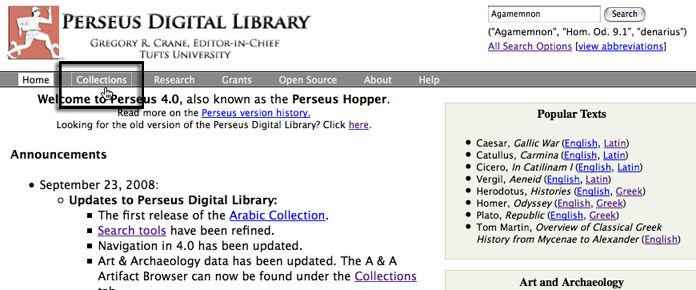
Perseus Digital Library
The Perseus Project is an evolving digital library of resources for the study of the humanities. It is aimed to perform research on developing tools to provide users with improved access to various types of materials. Past work has focused on building and linking together collections. Current work considers ways of developing and refining tools for presentation of the materials in the Perseus DL.
Wednesday, 2 June 2010
Trailblazing
The Trailblazing website provides a timeline with key articles and historical events mapped out. Very nice and well worth spending a lunch-hour perusing!

Saturday, 1 May 2010
Saturday, 21 November 2009
ASYLUM: Inside the Closed World of State Mental Hospitals
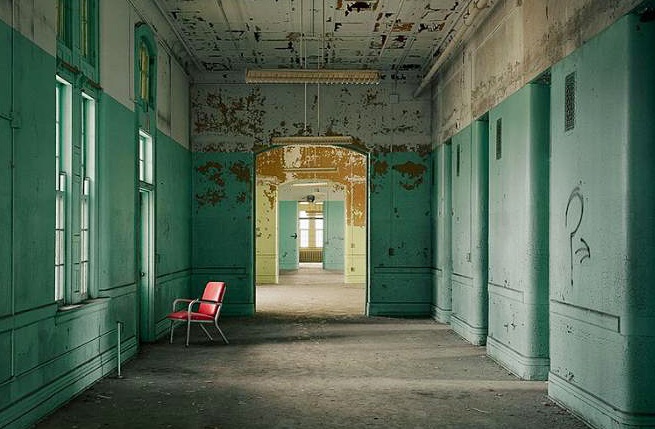 We tend to think of mental hospitals as “snake pits”—places of nightmarish squalor and abuse—and this is how they have been portrayed in books and film. Few Americans, however, realize these institutions were once monuments of civic pride, built with noble intentions by leading architects and physicians, who envisioned the asylums as places of refuge, therapy, and healing. For more than half the nation’s history, vast mental hospitals—some of the largest structures ever built in America—were a prominent feature of the American landscape. From the mid-nineteenth century to the early twentieth, over 250 institutions for the insane were built throughout the United States. But in the second half of the twentieth century, after the introduction of psychotropic drugs and policy shifts toward community-based care, patient populations declined dramatically, leaving many of these massive buildings neglected and abandoned. Asylum: Inside the Closed World of State Mental Hospitals is a collection of large-format photographs taken by photographer Chris Payne, who was granted unprecedented access to seventy institutions in thirty states between 2002 and 2008. Through his lens we see palatial exteriors designed by famous architects and crumbling interiors never intended to be seen again. He shows how the hospitals functioned as self-contained communities, where almost everything of necessity was produced on site: food, water, power, and even clothing and furniture. Since many of these places no longer exist, his photographs serve as their final, “official” record.Accompanying the contemporary views are historic plans, drawings, and photographs, as well as an essay by world-renowned author and neurologist Dr. Oliver Sacks, who describes his own experience working at a state mental hospital. Sacks pays tribute to Payne's photographs and to the lives once lived in these places, “where one could be both mad and safe”.
Wednesday, 4 November 2009
Mark Twain, illuminated
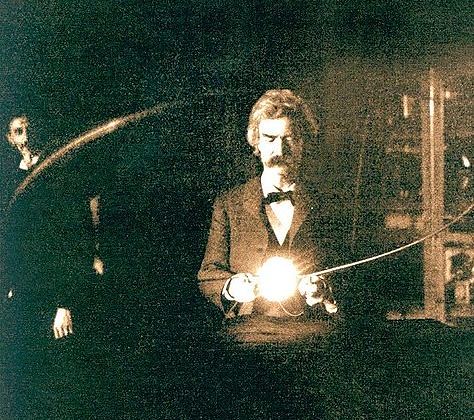 From a 1895 article called Tesla's Osillator and Other Inventions, a photo of Mark Twain with one of Tesla's marvelous contraptions.
Saturday, 7 March 2009
The Iceman Photo Scan
 The Iceman Photo Scan is an innovative project which records the complete photographic documentation of the body of the Iceman mummy. Thanks to 12 differing angle-shots it is possible to see the whole body of the mummy. The intuitive zoom function enables a high-resolution navigation, from a total body image down to millimetric detail. The image at any enlargement guarantees both a perfect view and accurate colour reproduction. More
Monday, 24 November 2008
Magic and the Brain: How Magicians "Trick" the Mind
 Magicians have been testing and exploiting the limits of cognition and attention for hundreds of years. Neuroscientists are just beginning to catch up.But the most versatile instrument in their bag of tricks may be the ability to create cognitive illusions. Like visual illusions, cognitive illusions mask the perception of physical reality. Yet unlike visual illusions, cognitive illusions are not sensory in nature. Rather they involve high-level functions such as attention, memory and causal inference. With all those tools at their disposal, well-practiced magicians make it virtually impossible to follow the physics of what is actually happening—leaving the impression that the only explanation for the events is magic.
Neuroscientists are just beginning to catch up with the magician’s facility in manipulating attention and cognition. Of course the aims of neuroscience are different from those of magic; the neuroscientist seeks to understand the brain and neuron underpinnings of cognitive functions, whereas the magician wants mainly to exploit cognitive weaknesses. Yet the techniques developed by magicians over centuries of stage magic could also be subtle and powerful probes in the hands of neuroscientists, supplementing and perhaps expanding the instruments already in experimental use.
Neuroscience is becoming familiar with the methods of magic by subjecting magic itself to scientific study—in some cases showing for the first time how some of its methods work in the brain. Many studies of magic conducted so far confirm what is known about cognition and attention from earlier work in experimental psychology. A cynic might dismiss such efforts: Why do yet another study that simply confirms what is already well known? But such criticism misses the importance and purpose of the studies. By investigating the techniques of magic, neuroscientists can familiarize themselves with methods that they can adapt to their own purposes. Indeed, we believe that cognitive neuroscience could have advanced faster had investigators probed magicians’ intuitions earlier. Even today magicians may have a few tricks up their sleeves that neuroscientists have not yet adopted.
By applying the tools of magic, neuroscientists can hope to learn how to design more robust experiments and to create more effective cognitive and visual illusions for exploring the neural bases of attention and awareness. Such techniques could not only make experimental studies of cognition possible with clever and highly attentive subjects; they could also lead to diagnostic and treatment methods for patients suffering from specific cognitive deficits—such as attention deficits resulting from brain trauma, ADHD (attention-deficit hyperactivity disorder), Alzheimer’s disease, and the like. The methods of magic might also be put to work in “tricking” patients to focus on the most important parts of their therapy, while suppressing distractions that cause confusion and disorientation (Full text).
Wednesday, 24 September 2008
Codex Ixtlilxochitl
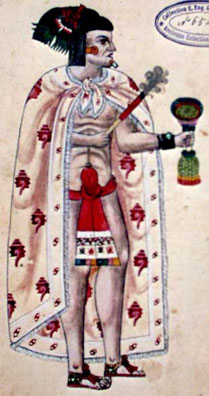 This is a manuscript with illustrations on European paper in folio, text in the Spanish language and is a fragment of a codex attributed by Leon y Parma to Don Fernando de Alva Ixtlilxochitl who was a "nobleman" of the Confederation of Culhua Mexica ("Aztec Empire") and the outstanding native historian of the early years of the Spanish Conquest. The codex deals with people and events of the pre-Conquest "Aztec Empire", which Ixtlilxochitl remembered. This will, naturally, be indispensible for any complete Latin American Library.
Saturday, 5 July 2008
Does the Sun look smaller to you?
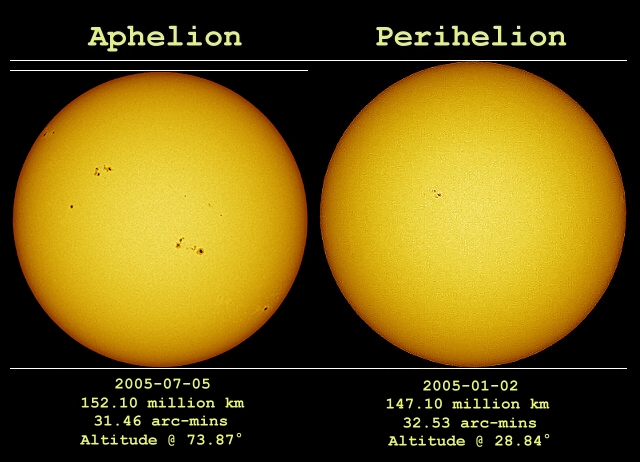 Criminy, I almost forgot: today, July 4th, at roughly 08:00 UT, the Earth was at aphelion.
Uh, what? I hear you ask. OK, brief astrolesson for ya, then back to the grill!
The Earth does not orbit the Sun in a perfect circle. The orbit is slightly elliptical. If you were to draw the Earth’s orbit on a piece of paper, you’d need a sharp eye to detect its non-circularity, but deviant it is. What this means in real terms is that the Earth ranges from about 148 to about 152 million kilometers from the Sun over the course of six months (which is how long it takes to get from one side of the orbit to the other, of course).
When the Earth is closest to the Sun it’s at perihelion, and when it’s farthest it’s called aphelion (I usually pronounce that app-helion, if you care, though I’ve heard others say aff-helion). So today we passed aphelion, and slowly but inexorably, over the next six months we’ll draw slightly closer to the Sun, and then the whole thing repeats.
That 4 million km difference sounds like a lot. But over the 150 million average radius of the orbit it’s only a slight difference by eye. The Sun will look about 3% larger at perihelion versus aphelion, and you’d never notice that, especially since the change is slow and takes six months. The amount of sunlight hitting the Earth does increase at perihelion, being about 5% greater than at aphelion. That’s quite a bit! But the effect isn’t as bad as you’d think. Why not?
For us northern hemisphere folks, we are farthest from the Sun in summer, and closest in winter, so that mitigates the temperature extreme. On average, winters are a bit warmer and summers a bit cooler. But wait! In the southern hemisphere, the seasons are reversed! So they should have extra hot summers and extra cold winters.
But they don’t. Why not? Because the southern hemisphere is mostly water. Go ahead, find a globe and take a look; it’s incredible how much of that half the Earth is water bound. Water absorbs and releases heat slowly, so all summer the oceans suck down that extra solar energy, and release it all winter. That helps balance out the temperature extremes.
Oh, one more thing: the Earth precesses, that is, the axis of rotation moves like a wobbling top. It takes a long time for the wobble to make one cycle, well over 20,000 years. But this changes the timing of the seasons compared to the orbit. In a few millennia, we’ll have perihelion at the same time as northern summer, and aphelion at northern winter. It’s hard to say what effect this will have on the environment, since it brings extra-hot summers and extra-cold winters. However, the last time this happened was around the same time the Sahara forest went away and was replaced by, well, guess.
But for today, don’t fret too much about wandering poles and aphelion… except to say, if you’re out sweltering in the Sun today celebrating the holiday in the U.S., you might want to take just a moment and be glad our orbit isn’t more elliptical, or that it isn’t 15,000 AD.
Sunday, 17 February 2008
Atlas of Human History
 Where do you really come from? And how did you get to where you live today? DNA studies suggest that all humans today descend from a group of African ancestors who—about 60,000 years ago—began a remarkable journey.
The Genographic Project is seeking to chart new knowledge about the migratory history of the human species by using sophisticated laboratory and computer analysis of DNA contributed by hundreds of thousands of people from around the world. In this unprecedented and real-time research effort, the Genographic Project is closing the gaps of what science knows today about humankind's ancient migration stories.
The Genographic Project is a five-year research partnership led by National Geographic Explorer-in-Residence Dr. Spencer Wells. Dr. Wells and a team of renowned international scientists and IBM researchers, are using cutting-edge genetic and computational technologies to analyze historical patterns in DNA from participants around the world to better understand our human genetic roots. The three components of the project are: to gather field research data in collaboration with indigenous and traditional peoples around the world; to invite the general public to join the project by purchasing a Genographic Project Public Participation Kit; and to use proceeds from Genographic Public Participation Kit sales to further field research and the Genographic Legacy Fund which in turn supports indigenous conservation and revitalization projects. The Project is anonymous, non-medical, non-political, non-profit and non-commercial and all results will be placed in the public domain following scientific peer publication.
Enter
Subscribe to:
Posts (Atom)