Saturday, 1 May 2010

Tuesday, 23 March 2010
Nature by Numbers
A movie inspired on numbers, geometry and nature, by Cristóbal Vila. Go to www.etereaestudios.com for more info: theory behind, stills, screenshots, tutorials and workshops.
Saturday, 12 December 2009
Saturday, 21 November 2009
ASYLUM: Inside the Closed World of State Mental Hospitals
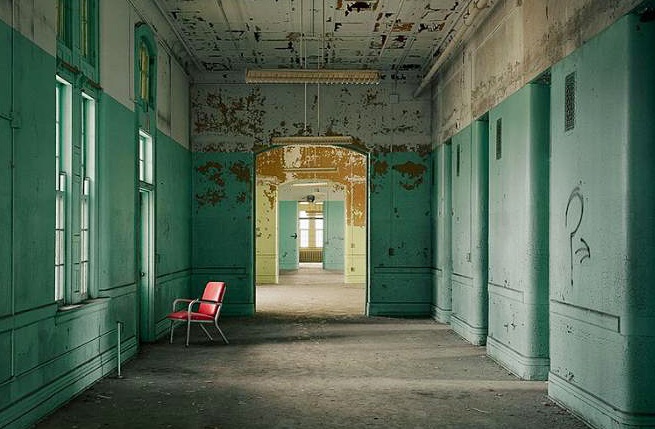 We tend to think of mental hospitals as “snake pits”—places of nightmarish squalor and abuse—and this is how they have been portrayed in books and film. Few Americans, however, realize these institutions were once monuments of civic pride, built with noble intentions by leading architects and physicians, who envisioned the asylums as places of refuge, therapy, and healing. For more than half the nation’s history, vast mental hospitals—some of the largest structures ever built in America—were a prominent feature of the American landscape. From the mid-nineteenth century to the early twentieth, over 250 institutions for the insane were built throughout the United States. But in the second half of the twentieth century, after the introduction of psychotropic drugs and policy shifts toward community-based care, patient populations declined dramatically, leaving many of these massive buildings neglected and abandoned. Asylum: Inside the Closed World of State Mental Hospitals is a collection of large-format photographs taken by photographer Chris Payne, who was granted unprecedented access to seventy institutions in thirty states between 2002 and 2008. Through his lens we see palatial exteriors designed by famous architects and crumbling interiors never intended to be seen again. He shows how the hospitals functioned as self-contained communities, where almost everything of necessity was produced on site: food, water, power, and even clothing and furniture. Since many of these places no longer exist, his photographs serve as their final, “official” record.Accompanying the contemporary views are historic plans, drawings, and photographs, as well as an essay by world-renowned author and neurologist Dr. Oliver Sacks, who describes his own experience working at a state mental hospital. Sacks pays tribute to Payne's photographs and to the lives once lived in these places, “where one could be both mad and safe”.
Wednesday, 4 November 2009
Mark Twain, illuminated
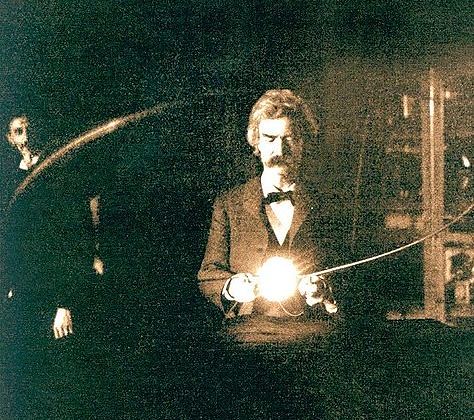 From a 1895 article called Tesla's Osillator and Other Inventions, a photo of Mark Twain with one of Tesla's marvelous contraptions.
Tuesday, 15 September 2009
The shape of the book
 It is impossible to establish exactly when the book was invented or first began to circulate. Indeed, none of the forms exhibited here can be considered the embryo of what we have come to refer to as books. Nevertheless, if we narrow our scope to the Laurentian manuscript collection—in itself quite extensive—it would appear that the potsherd on which, probably under dictation, a pupil from the 2nd century BC wrote the ancient verses of one of Sappho’s odes marks the most significant threshold of its history; the fragment represents the longest extant portion of the poem, which may have been dedicated to Aphrodite. The ostracon is a rare medium due solely to the fact that, since it is a fragile material that was not used for anything meant to endure, large quantities have not been handed down to us. The book form we chose as our endpoint—and thus closer to our own era—is a 19th-century Japanese erotic-grotesque scroll expressing a genre that enjoyed widespread and lasting circulation because of its caricatural and entertaining contents. Due to its distant provenance, however, it is a rarity in Italian libraries. Between these two intentionally striking extremes, we have created an itinerary that requires some explanation.
Thursday, 2 April 2009
Flat Lizard colourful displays & fly catching
Watch the beautiful displays of the Flat Lizard and see the amazing acrobatics performed in the quest for a black fly dinner. Learn more about the fascinating world of the colourful Flat Lizard in this brilliant wildlife video from Sir David Attenborough's natural history masterpiece, Life in Cold Blood (see video).
Saturday, 7 March 2009
The Iceman Photo Scan
 The Iceman Photo Scan is an innovative project which records the complete photographic documentation of the body of the Iceman mummy. Thanks to 12 differing angle-shots it is possible to see the whole body of the mummy. The intuitive zoom function enables a high-resolution navigation, from a total body image down to millimetric detail. The image at any enlargement guarantees both a perfect view and accurate colour reproduction. More
Saturday, 24 January 2009
Darwin Big Idea
 Darwin is the biggest ever exhibition about Charles Darwin. It celebrates Darwin's ideas and their impact for his 200th birthday in 2009. Discover the man and the revolutionary theory that changed our understanding of the world. See incredible, revealing and rare exhibits, some on display for the first time (more at The Natural History Museum, London.
Monday, 24 November 2008
Magic and the Brain: How Magicians "Trick" the Mind
 Magicians have been testing and exploiting the limits of cognition and attention for hundreds of years. Neuroscientists are just beginning to catch up.But the most versatile instrument in their bag of tricks may be the ability to create cognitive illusions. Like visual illusions, cognitive illusions mask the perception of physical reality. Yet unlike visual illusions, cognitive illusions are not sensory in nature. Rather they involve high-level functions such as attention, memory and causal inference. With all those tools at their disposal, well-practiced magicians make it virtually impossible to follow the physics of what is actually happening—leaving the impression that the only explanation for the events is magic.
Neuroscientists are just beginning to catch up with the magician’s facility in manipulating attention and cognition. Of course the aims of neuroscience are different from those of magic; the neuroscientist seeks to understand the brain and neuron underpinnings of cognitive functions, whereas the magician wants mainly to exploit cognitive weaknesses. Yet the techniques developed by magicians over centuries of stage magic could also be subtle and powerful probes in the hands of neuroscientists, supplementing and perhaps expanding the instruments already in experimental use.
Neuroscience is becoming familiar with the methods of magic by subjecting magic itself to scientific study—in some cases showing for the first time how some of its methods work in the brain. Many studies of magic conducted so far confirm what is known about cognition and attention from earlier work in experimental psychology. A cynic might dismiss such efforts: Why do yet another study that simply confirms what is already well known? But such criticism misses the importance and purpose of the studies. By investigating the techniques of magic, neuroscientists can familiarize themselves with methods that they can adapt to their own purposes. Indeed, we believe that cognitive neuroscience could have advanced faster had investigators probed magicians’ intuitions earlier. Even today magicians may have a few tricks up their sleeves that neuroscientists have not yet adopted.
By applying the tools of magic, neuroscientists can hope to learn how to design more robust experiments and to create more effective cognitive and visual illusions for exploring the neural bases of attention and awareness. Such techniques could not only make experimental studies of cognition possible with clever and highly attentive subjects; they could also lead to diagnostic and treatment methods for patients suffering from specific cognitive deficits—such as attention deficits resulting from brain trauma, ADHD (attention-deficit hyperactivity disorder), Alzheimer’s disease, and the like. The methods of magic might also be put to work in “tricking” patients to focus on the most important parts of their therapy, while suppressing distractions that cause confusion and disorientation (Full text).
Friday, 21 November 2008
LIFE photo archive
 Search millions of photographs from the LIFE photo archive, stretching from the 1750s to today. Most were never published and are now available for the first time through the joint work of LIFE and Google (go).
Saturday, 4 October 2008
The Collegiate Church of Saint Isidoro
 At the northeast side of the roman encampment Legio VII Gemina (Leon) (now in Spain), by the camp wall, King Sancho the Fat (dead in 966), son of Ramiro 2nd, built a monastery for sheltering the rests of the martyr boy from Cordoba, St. Pelayo (we can see a sculpture of him in the front of the church). Her sister, a nun called Elvira Ramirez, moved with all the nuns of her elder monastery, Palat del Rey, to the new one. In the last Xth century, due to the arrival of Almanzor's army, the nuns went to Oviedo for refuge. The monastery of St. Pelayo in Leon was razed by the Arabic chief troops. King Alfonso the Vth (999-1027) rebuilt the monastery using very poor materials, like clay and bricks. Once more, a community of nuns established there, for taking care of the Royal cemetery, where the King had moved the rests of his predecessors, who were dispersed along various kingdom churches; even his parents's, Vermudo the IInd and Elvira.
The daughter of Alfonso the Vth, Doña Sancha, first infant and after the Queen herself, tried to exalt the monastery to the highest dignity, helped by her husband, King Fernando the Ist (1037-1065).
They rebuilt the elder brick monastery out of stone and so began the romanic style in their kingdom. They choose the portic of the church as a cemetery and ordered to be buried there. .
They wanted to dignify their church with relevant saints relics; they achieved the moving of St. Isidoro's corpse from Sevilla and St. Vicente's from Avila. They made an extraordinary feast in december, 21st, 1063, and next day they celebrated the moving of St. Isidoro. For this special event, they made splendid donations, jewels and ornaments, that we know nowadays as the Treasure of Leon.
Fernando and Sancha's daughter, infant Urraca Fernandez (dead in 1101), enlarged the church and made splendid donations, like the well known chalice. Another infant, Doña Sancha Raimundez (dead in 1159), with her brother, Emperor Alfonso the VIIth, continued the works in the elder church, began by her grand aunt Doña Urraca, and consecrated the new church in 1149. A year before they had substituted the benedictine female comunity in the monastery by an ordinary prebendaries Council. They ruled the temple and the abbey until 1956, when the council was changed into a secular priests institution, and since then it takes care of the liturgical and intellectual life of the Collegiate Church, the Temple, the Museums open to thousands of visitors, both national and foreign, the Archives and the Library at the disposal of researchers, the Isidorian Editorial and Bookstore, with the main purpose of divulging the history and the art the Collegiate Church and the life of Saint Isidoro.
Subscribe to:
Posts (Atom)